Efflorescence on Tiles and Stone: How to Remove It and Stop It Coming Back
White salt bloom on stone walls and steps? Here is how to remove it and cut water absorption so efflorescence is far less likely to return.


White, powdery patches on a stone wall, a sandstone jaali or an exterior granite step are a classic sign of efflorescence on natural stone. Water soaks into the stone, dissolves salts from the stone, the mortar or the wall behind it, and carries them to the surface. When the water evaporates, the salts stay behind as a white bloom. In Mumbai and along the coast, heavy monsoon rain followed by hot, dry weather makes this a familiar sight on facades, compound walls and terraces. The same white powder also shows up on tiles and grout lines, covered in its own section below.
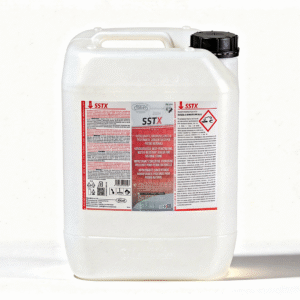
This guide is for homeowners, contractors and facility managers who have cleaned efflorescence off once and want to slow it down from coming back. The idea is simple: reduce how much water the stone can absorb. That is the job of Faber SSTX, a concentrated water repellent for natural stone.

Efflorescence on tiles and grout: how to remove it
The same white bloom often appears on ceramic, vitrified and porcelain tiles and along cement grout lines, usually in the first months after tiling or wherever water gets under the tiles, such as balconies, terraces and bathroom floors. Because ceramic and porcelain tiles are acid-resistant, the salts can be dissolved with an acid cleaner:
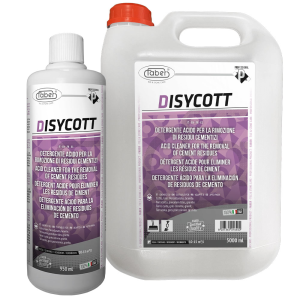
- Faber Disycott, a concentrated acid cleaner for after installation. Faber advises diluting it 1:4 for porcelain after tiling and 1:2 for salt deposits on cotto. Scrub, then rinse thoroughly with clean water.
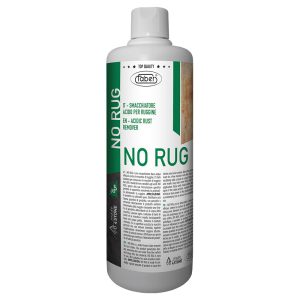
- Faber No Rug, a rust remover for acid-resistant surfaces that is also highly effective against salt efflorescence and oxidation.
Never use acid on marble, limestone, Kota stone or any other calcareous stone: it etches the surface. On these stones, brush the salts off dry, rinse with clean water and let the stone dry out completely. Whatever the surface, efflorescence comes back until the source of water is fixed, which is why a breathable water repellent such as Faber SSTX, below, is the long-term answer. For cement haze after tiling, see our guide to removing cement stains from tiles, and for everyday cleaning, our tile cleaners.
What Faber SSTX is (and when to use it)
Faber SSTX is a highly concentrated water repellent for natural stone and other absorbent mineral surfaces. It is an impregnator: it penetrates into the stone rather than sitting on top, and forms a durable, breathable, water-repelling barrier inside the pores. It:
- reduces water absorption;
- helps reduce efflorescence and weather-related deterioration;
- keeps the stone’s natural appearance and its ability to breathe;
- is suitable for both interior and exterior use.
Because it does not change how the stone looks, it suits surfaces where you want protection without a wet look or a shine: exposed stone cladding, boundary walls, steps, window surrounds and garden features.
Be clear about two limits. A water repellent slows the cause of efflorescence; it does not dissolve salts already on the surface, so those must come off first. And if water is entering from behind the stone, such as a leaking terrace, a broken pipe or damp rising from the ground, that source has to be fixed too. No surface treatment can keep up with a constant supply of water from inside the wall.
For Faber SSTX, the document we currently publish is a safety data sheet (MSDS), not a full technical data sheet. So take the dilution, coverage and drying times from the product label or from our team rather than guessing.
What you need
- Faber SSTX
- A stiff, dry nylon brush and a vacuum cleaner to remove loose salt deposits
- Clean water and lint-free cloths for general cleaning
- An applicator that suits the label instructions (penetrating sealers are commonly applied by brush, roller or low-pressure sprayer)
- Masking tape and plastic sheet to protect glass, metal frames, paint and plants
- Protective equipment: chemical-resistant gloves, airtight goggles with a face visor, long sleeves and safety footwear, as advised in the safety data sheet
Step-by-step: how to treat efflorescence on natural stone
- Find and fix the water source. Check gutters, terrace cracks, plumbing, planters and soil heaped against the wall. Treat the stone only after the source has been dealt with.
- Remove existing efflorescence dry. Brush off the white deposits with a stiff dry brush and vacuum them away. Flooding the wall with water can simply push the salts back into the stone.
- Clean the surface. Remove dust, dirt, moss and any old coatings so the product can penetrate evenly.
- Let the stone dry right through. Penetrating treatments need clean, dry stone. After rain or washing, allow enough dry days for the stone to dry fully, and do not start if rain is forecast.
- Protect nearby surfaces. Mask glass, painted areas and especially aluminium, zinc (galvanised) and tin fittings. The safety data sheet notes that the sodium silicate in the product may react with these metals.
- Test a small patch. Apply to an inconspicuous area, let it dry, then check the appearance and splash a little water on it to see how it behaves.
- Dilute and apply exactly as the label says. Faber SSTX is a concentrate, so follow the stated dilution and coverage. Apply evenly, work in manageable sections and do not let the product run or form puddles.
- Keep it dry while it cures for the time given on the label, then check the result. Water should bead up or soak in far more slowly than on untreated stone.
Tips and common mistakes
- Expect a little bloom in the first weeks if the wall was very wet. Salts already deep in the stone can still surface as it dries out; simply dry-brush them off again.
- Do not use acid cleaners before or after treatment without advice. The safety data sheet says to keep the product away from acids, and acids can etch marble and limestone anyway.
- Never treat damp stone. It is the most common reason for patchy, disappointing results.
Safety and storage
Handle Faber SSTX with care. Its safety data sheet classifies the concentrate as corrosive, with the signal word “Danger” and the warning “Causes severe skin burns and eye damage”. It is strongly alkaline (pH 11.5 to 12.5 at 5% concentration).
- Wear chemical-resistant gloves, airtight goggles with a visor, long sleeves and safety shoes. Do not breathe spray mist and keep the area well ventilated.
- On skin: remove contaminated clothing and wash with plenty of running water. In eyes: rinse with plenty of water for at least 15 minutes, holding the eyelids open, and get medical help.
- Keep the product away from acids, and do not eat, drink or smoke while using it.
- Do not let the product enter drains, surface water or ground water.
- Store only in the original container, tightly closed, in a well-ventilated place away from direct sunlight. As with any chemical, keep it out of reach of children.
Frequently asked questions
Will Faber SSTX change the colour of my stone?
No. It is designed to protect natural stone without changing its appearance, and it keeps the stone breathable. Always test a small, hidden area first to confirm the result on your particular stone.
Can Faber SSTX be used indoors as well as outside?
Yes. It is suitable for interior and exterior use on natural stone and other absorbent mineral surfaces.
Does Faber SSTX remove efflorescence that is already there?
No. It reduces how much water the stone absorbs, which helps reduce future efflorescence. Brush off the existing salt deposits and let the stone dry fully before you apply it.
Need help?
You can order Faber SSTX from Flagstone Fix and ask us for the label dilution and coverage for your stone. If efflorescence on natural stone keeps returning on exterior walls, cladding or facades, our team can clean and treat the surface for you through our Facade Cleaning & Sealing service. Send a few photos on WhatsApp to +91 87792 40420 and we will advise.
Dealing with a different stain? Our stain removal guide has a stain-by-stain chart for marble, granite and tiles, covering oil, tea, coffee, rust, cement, hard water, epoxy, paint and mould.