Rust Stains on Granite or Vitrified Tiles? How to Remove Them
Orange rust rings from cylinders, planters and grills can be lifted from granite, porcelain and other acid-resistant surfaces. Here is the method.


Rust stains are one of the most common complaints on Indian floors and terraces. A gas cylinder left in one spot, a metal planter stand on the balcony, iron furniture legs, grills dripping during the monsoon, or iron-rich borewell water from a garden tap can all leave stubborn orange rings on granite, vitrified tiles and sandstone. Here is how to remove rust stains from granite and other acid-resistant surfaces without damaging them.
Ordinary cleaners rarely shift them, because the oxide sits inside the surface. This guide explains how to remove them with Faber No Rug, a dedicated rust remover for acid-resistant materials. It is written for homeowners, housing society managers and maintenance teams.

What Faber No Rug is (and when to use it)
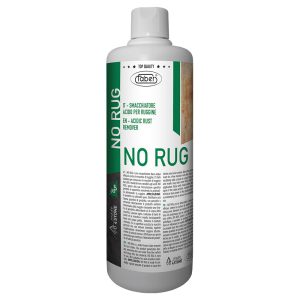
Faber No Rug is a ready-to-use, water-based rust stain remover with an acid pH. It penetrates deeply into the material to extract deep rust stains, and it is also effective on salt efflorescence and oxidation marks. It can be used indoors and outdoors.
The data sheet lists it for quartz-resin agglomerates, slate, sandstone, basaltina (lava stone), molten basalt, glazed ceramic, clinker, terracotta, granite, polished, natural and structured porcelain stoneware (what we call vitrified tiles in India), facing brick, reconstructed stone, porphyry, quartzite and tuff.
When not to use it: on any material sensitive to acids. That rules out marble, limestone and travertine, which can be damaged. If you are not sure what your stone is, ask us before you start.
What you need
- Faber No Rug (1 litre bottle)
- A brush or spatula, or apply directly from the bottle
- Plastic film to cover long-dwell applications
- Cloths and paper towels, or a mop for larger areas
- Clean water for rinsing
- Acid-resistant gloves and eye protection
Step-by-step: how to remove rust stains from granite
- Confirm the material is acid-resistant. Granite, porcelain and sandstone are fine; marble and limestone are not.
- Clean the area. Remove dust and dirt. If the surface has been waxed or treated, strip it first so the product can reach the stain.
- Pick a cool time. Apply when the surface is between 5 and 40°C, never on heated surfaces or in direct sunlight. On terraces, early morning or evening works best.
- Protect surrounding areas that are not being treated, including plants and metal fittings.
- Test first on an unexposed area or spare tile to check suitability and how long the stain needs.
- Apply evenly. Cover the whole stain, and preferably the whole tile, so the result is even.
- Let it work. Allow 30 to 60 minutes for surface rust on compact, low-absorbency material; 1 to 4 hours for deeper stains on porous material; 8 to 24 hours for very deep, stubborn stains on very absorbent stone.
- Cover long applications. For long dwell times, cover with plastic so it does not dry out. Remove the cover and leave the area exposed for 30 to 60 minutes before cleaning up.
- Remove and rinse. Lift residues with cloths or paper towels, or a mop on large areas, then rinse thoroughly with clean water.
- Judge the result when dry. If the stain persists, repeat the application. For very deep stains, light grinding first helps the product penetrate.
Tips and common mistakes
- Don’t mix it with other products. The only product Faber No Rug can be mixed with is FABER POULTICE.
- Treat whole tiles, not spots. Applying to a larger area than the stain avoids patchy, cleaner-looking circles.
- Be patient on porous stone. Deep stains in sandstone can need many hours, not minutes.
- Wait on new installations. On recently laid or grouted floors, let the adhesive or grout cure completely first.
- Protect afterwards. Once the stain is gone, apply a water-resistant treatment suited to the material to reduce repeat staining.
Safety and storage
Always use suitable personal protective equipment, such as gloves and eye protection, and follow the safety data sheet. Indoors, ensure good ventilation; outdoors, protect nearby plants and finishes. Keep children and pets away from the area until it has been rinsed and dried. Tools can be washed with water afterwards. Store the container tightly closed in a cool, dry place; shelf life is 24 months in the original sealed pack.
Frequently asked questions
Can I use Faber No Rug on marble?
No. It has an acid pH and is not suitable for acid-sensitive materials. Marble, limestone and travertine can be damaged, so use it only on acid-resistant surfaces such as granite and porcelain.
How long should I leave it on a rust stain?
It depends on the stain and the material: 30 to 60 minutes for surface rust on compact stone, 1 to 4 hours for deeper stains on porous materials, and 8 to 24 hours for very deep, stubborn stains.
When can I walk on the floor again?
The data sheet says you can resume use of the surface 2 to 3 hours after application, once residues have been removed and the area rinsed.
Need help?
Buy Faber No Rug from Flagstone Fix, or let our team identify the stone and remove rust stains from granite, porcelain and other surfaces for you with our Stone Cleaning service. Send a photo of the stain on WhatsApp at +91 87792 40420.
Dealing with a different stain? Our stain removal guide has a stain-by-stain chart for marble, granite and tiles, covering oil, tea, coffee, rust, cement, hard water, epoxy, paint and mould.