
Vitrified Tiles Lost Their Shine? A Re-Polishing Guide
Polished vitrified tiles and quartz go dull and grab dirt over time. Here's how a water-based polishing cream re-polishes and seals them.

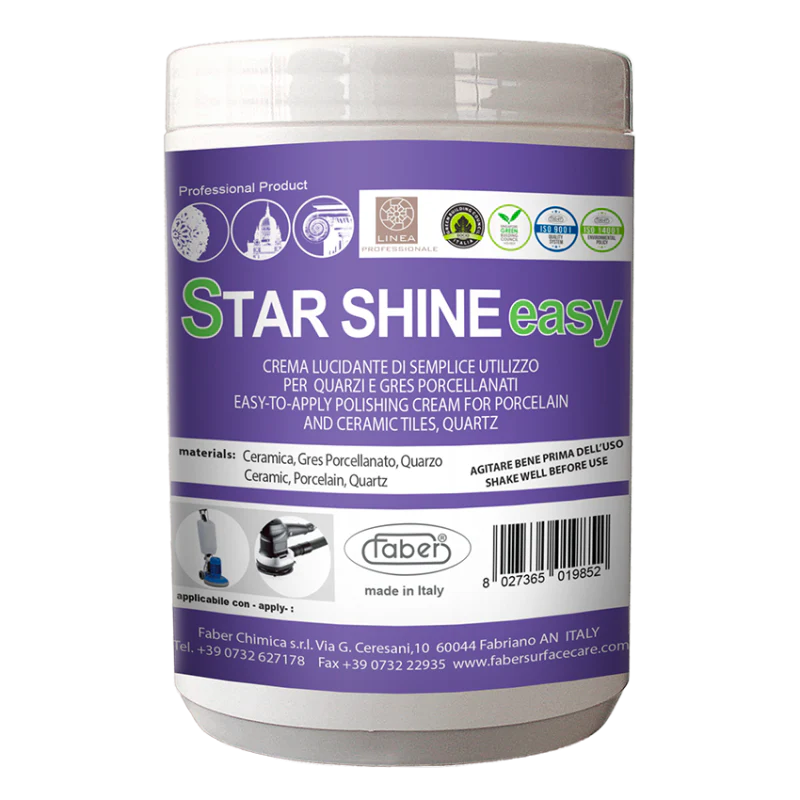
Polished vitrified tiles are in almost every new Indian flat and office, and sooner or later most owners want to restore shine on vitrified tiles that have gone dull. When they are new they look like glass. A few years later the shine has faded in the walkways, dirt seems to settle into the surface, and mopping no longer brings them back.
You can’t re-grind a tile the way you would a marble floor, but you can re-polish and seal it. This guide is for homeowners, builders handing over flats and facility managers. We use Faber Star Shine Easy, a water-based polishing cream made for man-made surfaces.

What Faber Star Shine Easy is (and when to use it)
Faber Star Shine Easy is a water-based polishing cream with a formula designed to re-polish man-made materials: polished or glazed polished porcelain tiles and slabs, polished quartz and ceramic. In Indian terms that covers polished vitrified tiles and glazed vitrified tiles (GVT/PGVT) with a polished face, plus quartz floors and tops.
As it is buffed in, it seals the porosity of the surface. That gives good resistance to foot traffic and staining agents and makes daily maintenance easier. The data sheet describes the finish as sharp brightness, and it can be used indoors and outdoors.
It is the sister product of Faber Star Shine, which is formulated for granite. Use the right one for the material.
When not to use it: the data sheet lists polished surfaces only; matt, textured or rustic tiles are not on that list. Don’t apply it to wet or overheated surfaces, or to newly laid tiles before the adhesive and grout have cured.
What you need
- Faber Star Shine Easy (1 kg or 5 kg bucket)
- Single-disc machine of at least 2.0 HP, or a manual rotary brush for small areas
- White pad, run at 150 to 200 rpm
- Teaspoon or scoop for dosing
- A cleaner for preparation (the data sheet suggests Faber Deterfug or FABER 30)
- Cloth, broom or vacuum cleaner and clean water for rinsing
- Masking tape for skirting and fittings, gloves and suitable PPE
Step-by-step: How to restore shine on vitrified tiles
- Deep clean. Remove all dust and dirt with Faber Deterfug or FABER 30, depending on the dirt and surface. Grease and old residues in the micro-pores of polished tiles must come out first. Let the floor dry completely.
- Check conditions. Work on surfaces between +5 and +40°C that are not overheated. Protect skirting, doors and anything you aren’t treating.
- Test. Try the process on a tile in a cupboard or behind furniture, or on a spare tile from the same batch.
- Shake and dose. The cream is a white paste that becomes creamier when shaken or buffed; consistency doesn’t affect performance. Place 2 to 3 teaspoons on the floor, which the data sheet indicates is enough for about a square metre.
- Buff in 0.5 m² sections. Start immediately with the single-disc machine and white pad at 150 to 200 rpm. Use circular passes to spread the cream evenly, broadening your movement towards the next section.
- Repeat across the floor, then remove the dry residues with a cloth, broom or vacuum.
- Add passes if needed. For worn floors, 2 to 3 applications per section. For maintaining shine, 1 to 2. The product does not cause layering defects.
- Rinse and reopen. After removing all residue, rinse with water. The floor can then be used. Wash tools and pads with water.
Tips and common mistakes
- Cleaning is half the job. The data sheet asks for a carefully cleaned surface, free of dust and dirt, before you start.
- Broaden your buffing movement towards the next section as you go, as the data sheet recommends.
- Check the tile type. Matt and textured tiles aren’t on the data sheet, so ask us before using it on them.
- Budget using the coverage of about 50 to 70 m² per kg. Two or three passes on a dull floor will use more.
- For daily care afterwards the data sheet recommends Faber Algafloor, and FABER 30 or Faber Deterfug for heavy-duty cleaning.
Safety and storage
- Use suitable personal protective equipment and follow the product safety data sheet. The cream is acidic (pH about 2.5), so wear gloves.
- Keep children and pets out of the area while the machine is running.
- Store the bucket tightly closed in a cool, dry place. Shelf life is 36 months in the original sealed packaging.
Frequently asked questions
Is Faber Star Shine Easy the same as Faber Star Shine?
No. Faber Star Shine is formulated for granite. Faber Star Shine Easy has a formula for man-made materials such as polished porcelain tiles and slabs, ceramic and quartz.
Will it make matt vitrified tiles glossy?
Matt tiles are not on its list. The data sheet lists polished or glazed polished porcelain tiles and slabs, polished quartz and ceramic. For matt or textured tiles, ask us about the right product.
When can I walk on the floor after polishing?
Once all residues are removed and the surface has been rinsed with water, the floor can be opened for use, according to the data sheet.
Need help?
Buy Faber Star Shine Easy from Flagstone Fix to restore shine on vitrified tiles yourself, or book our Flooring Restoration team to do it with professional machines. WhatsApp us at +91 87792 40420 with a photo of your tiles.


