Best Practices for Cleaning Stone and Tile Floors


Giving care to the hard surface floors, especially the floors covered with natural stone or ceramic material, needs considerate care. What is also important is that these surfaces help make a space look elegant and also amount to a long-term investment in material and installation.
However, normal foot traffic, exposure to the environment, and regular spills may wear out the finish, abrade sealants, and lead to residues. In businesses, hospitals, and luxury living complexes, the proper alkaline floor cleaner should be selected because of its performance and stability.
Understanding the Needs of Stone and Tile Surfaces
Contrary to synthetic flooring, stone and tile surfaces are different in terms of porosity, sensitivity, and chemical tolerance. For example:
- Marble and limestone are calcareous and can be etched by acidic or alkaline cleaners.
- Granite and quartzite are stronger still, yet they still require non-film-forming maintenance.
- Porcelain and ceramic tiles tend to collect dirt in grout joints, even though they are less absorbent.
In order to clean these surfaces, the trick is to find a floor-cleaning liquid that is capable of getting out the everyday dirt but is soft enough not to damage the material or, in the case of honed or polished surfaces, to alter the look of the finish.

Why Regular Floor Maintenance is Important in Commercial Spaces
In settings such as hotels, lobbies, retail spaces, and residential areas, flooring serves both a functional and a branding purpose. Clean, polished floors that are well-maintained demonstrate attention to detail, cleanliness, and professionalism.
- Can increase longevity and slip protection
- Can enhance natural appearance and brightness
- Can mitigate long-term restoration or replacement costs
- Ensures compliance with hygiene and safety regulations
However, an inappropriately applied cleaning agent can have a negative effect, sticky residue, damage to the flooring surface, or discoloration.
Choosing The Right Floor Cleaner: What To Look For
When selecting a floor cleaner for tile and stone floors, consider the following:
- Surface compatibility: Ensure that the product is designed to be compatible with ceramics, natural stone, and engineered surfaces.
- pH neutrality: A pH-neutral finish is required to preserve the finish on the stone and prevent etching.
- Non-residual formula: These neither stain nor stick to the surface, thus they best suit sealed or smooth surfaces.
- Concentrate vs. ready to use: The various versions of concentrate are versatile enough in dilution up to the soiling level.
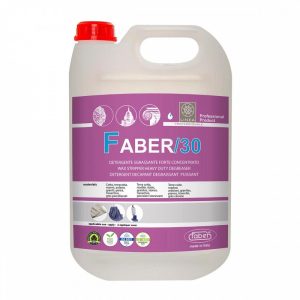
FABER 30, is a concentrated, neutral floor cleaner that is used on the daily cleaning of tile floors and stone floors. It is created to be effective for cleaning purposes without having the effect of ruining delicate surfaces as well as leaving deposits on surfaces, and this makes it applicable in most environments, whether public or privately owned.
Application Recommendations
Following these steps to ensure you optimize your tile cleaner or stone cleaner:
1. Dilute According to Application
You should dilute your floor cleaning liquid FABER 30, according to the recommendation made by the manufacturer (i.e., diluted 1:9 for regular cleaning with simple degreasing, and diluted 1:4 for heavy degreasing). If the floor cleaning is for a high-traffic area, the dilution might be stronger.
2. Appropriate Cleaning Equipment
You can use a microfiber mop, an auto-scrubber, or a low-speed machine; it all depends on the size and service of your space.
3. Do Not Rinse, If Not Necessary
A great product like FABER 30 was specifically designed to work as a leave-on product. Rinsing is not required unless you are removing very heavy dirt.
4. Check for Residues or Film
If you notice you are still building up or have a dulling effect over time, you should review your dilution ratio or the regularity of cleaning.


Before FABER 30
After FABER 30
Suggested Uses
A properly formulated floor cleaner can be used in a variety of industries and in various property types, including:
- Hotels & Hospitality: marble lobbies, stone stairs, guestroom flooring.
- Retail & showrooms: customers expect clean and attractive spaces.
- Corporate & public spaces: walking surfaces should always be clean and safe.
- Residential developments: Especially where natural stone is utilized as a premium finish.
Floor maintenance is more than just a housekeeping routine; it’s an integral part of asset care. Investing in the correct cleaning solutions can significantly extend the lifespan of high-quality materials while reducing the need for periodic restoration.
Whether you manage facilities, offer maintenance services, or specify materials as a design professional, selecting a cleaner that supports both appearance and durability, such as FABER 30, is a practical step toward maintaining flooring integrity over the long term.
To speak with our dedicated store care expert, please feel free to get in touch.