How to Seal Marble Floors the Right Way: A Complete Guide for Indian Homes and Commercial Spaces

Marble flooring is one of those investments that gives back quietly, every single day. The veining, the texture, the way it makes a room feel grounded and luxurious at the same time. There is a reason people have been laying marble in their homes for centuries.
In India, especially, marble floors face added pressure. Monsoon humidity, cooking oil splashes in kitchens, and heavy foot traffic during festivals and gatherings. The conditions here are harder on stone than most guides written for Western audiences acknowledge.
Sealing is what prevents that. Done right, it extends the life of the stone, keeps the surface looking the way it did on day one, and makes cleaning far less stressful. This guide walks you through everything: why sealing matters, how to choose the right product, how to apply it, and where most people go wrong.
Why Sealing Marble Floors Is Non-Negotiable
Marble is a metamorphic rock formed from limestone under extreme heat and pressure. While that gives it a dense, crystalline character, it does not make it impervious. Marble has pores, and those pores will absorb whatever lands on them if the surface is not sealed.
A quality marble sealer creates a barrier, either inside the pore structure or on the surface, that stops liquids, oils, and contaminants from working their way into the stone. It is also what protects against etching: those dull, slightly rough patches that appear when acidic substances like vinegar, citrus, or the wrong cleaning product make contact with unprotected marble.
And it is not just about defence. A good penetrating sealer actually brings out the stone’s best qualities, the depth of colour and the clarity of the veining. Properly sealed marble does not just last longer. It looks better.
Choosing the Right Marble Sealer: Penetrating vs. Layer Forming
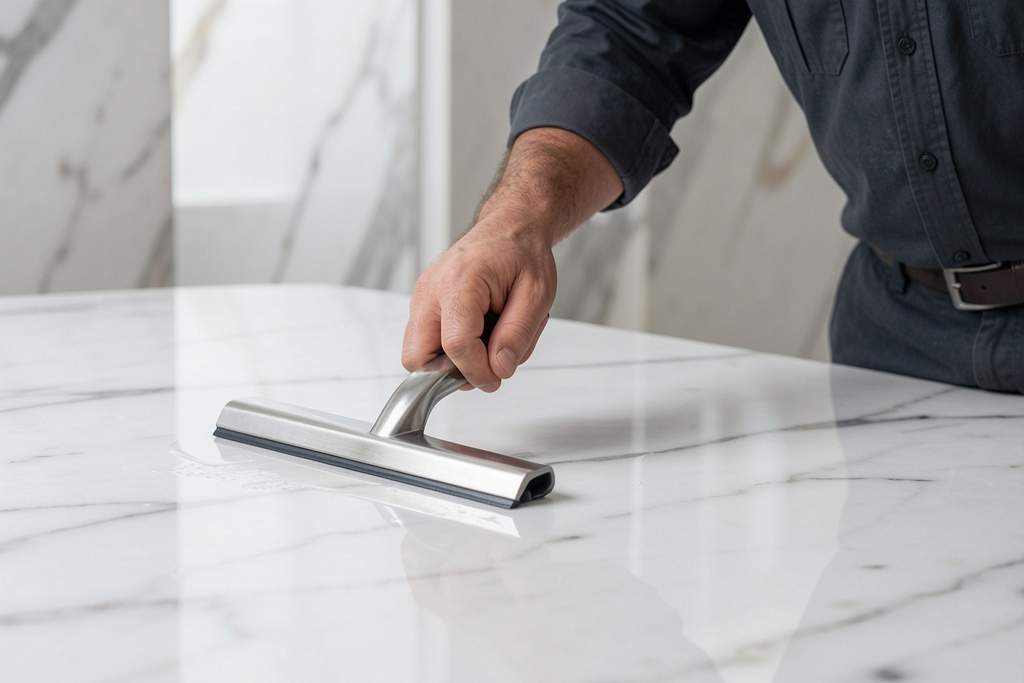
This is where most people make their first mistake, not out of carelessness, but simply because no one told them the difference matters.
Penetrating sealers, sometimes called impregnating sealers, go into the stone and fill the pores from within. They leave no film on the surface, which means no change to the look or feel of the marble. For polished surfaces or anywhere the natural finish needs to be preserved, these are the right choice. They also tend to last longer between applications.
Topical sealers sit on top of the stone and form a protective layer. They can add sheen and deepen colour, which works well on honed or textured finishes and high-traffic areas where the finish benefit is worth the trade-off of more frequent reapplication.
Products Worth Knowing
PROTEX by Faber Italy is a fast-drying, solvent-based treatment that works across marble, granite, limestone, travertine, quartzite and more. It protects without touching the stone’s colour or finish, and it is certified safe for surfaces in contact with food, making it a strong choice for marble kitchen countertops specifically. Technically, it sits between water-based and nano-based products in terms of molecular behaviour, which means it performs well on both compact and highly absorbent surfaces.
Vetro Power Professional Porous Stone Protector and Sealer is built around nanotech, a penetrating sealer that reacts within the pore structure itself to reduce liquid absorption while keeping the stone fully breathable. Invisible once applied, no film, no change to texture or slip resistance. It repels water, oil, and common staining agents, and it is eco-friendly and non-toxic. Works indoors and outdoors. Reapplication is generally recommended every 12 to 18 months, depending on traffic and exposure.
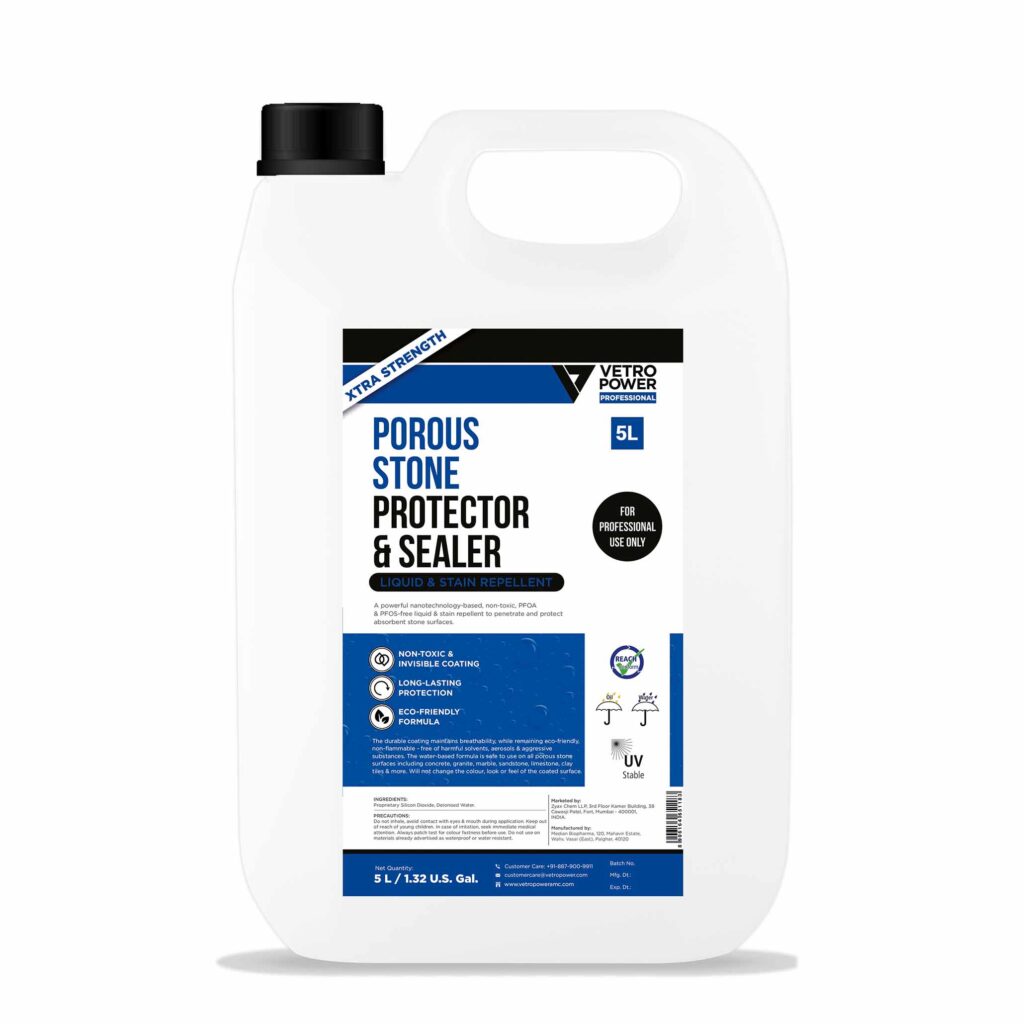
VETRO POWER PROFESSIONAL POROUS STONE PROTECTOR & SEALER
Professional porous stone protector and sealer for long-lasting protection against water, oil and stains
HIDRO SST by Faber Italy takes a different route: water-based, VOC-free, and LEED-certified. It is the sealer to reach for when environmental credentials are part of the brief, or when the stone has some residual moisture. It penetrates deep into natural stone to guard against water ingress and rising humidity without affecting breathability. Particularly well-suited to Indian climates where humidity is a year-round concern. Can also be paired with an anti-stain treatment for an extra layer of defence.
B1-700 by Faber Italy is specifically formulated for surfaces that are colour-sensitive, limestone in particular, which has a long history of looking worse after sealing if the wrong product is used. Solvent-based, fast-drying, UV-resistant, and non-yellowing. It builds an invisible hydrophobic and oleophobic barrier inside the stone’s capillary structure, so water, oils, and salts bead and run off rather than absorb. Coverage runs roughly 10 to 15 m2 per litre, depending on how porous the surface is. Shelf life is up to 24 months in sealed storage.
How to Seal Marble Floors: Step-by-Step
Step 1: Clean Thoroughly and Do Not Rush It
Sealing over a dirty surface does not protect the marble. It traps whatever is there. Use a pH-neutral cleaner made for natural stone. Work through the entire surface carefully, then let it dry completely before touching a sealer. Applying product to damp stone is one of the most common reasons sealers fail. If you need guidance on the right cleaner, read our guide on how to safely clean stone, marble and tiles.
Step 2: Match the Sealer to the Surface
Polished marble in a hallway and honed limestone on an outdoor terrace have very different needs. Read the technical data sheet for whichever product you are using, and if you are unsure, ask. Getting this decision right costs nothing. Getting it wrong costs considerably more.
Step 3: Apply in Thin, Controlled Sections
Pour a modest amount onto the surface and spread it evenly with a clean, lint-free cloth or applicator pad. Do not try to cover the whole floor in one pass. For penetrating sealers, let the product dwell for the manufacturer’s specified time, usually around 10 to 15 minutes, so it has a chance to actually work into the stone.
Step 4: Buff Off What Does Not Absorb
Any sealer sitting on the surface after the dwell time will dry into a residue that is sticky, dull, and dirt-attracting. Buff it off with a clean, dry cloth, moving in circular motions until the surface looks uniform. This step is what separates a good application from a frustrating one.
Step 5: Let It Cure Properly
Keep foot traffic and moisture off the surface until the sealer has fully cured. Depending on the product, that could be a few hours or a full 24. Check the guidelines and resist the temptation to rush it.
Step 6: Second Coat for High-Exposure Areas
Kitchens, bathrooms, and heavy-traffic commercial floors benefit from a second coat. Same process, same patience. Wait for the first coat to fully cure before applying.
Common Marble Sealing Mistakes and How to Avoid Them
Not cleaning before sealing. A pH-neutral clean before every application is not optional. It is the foundation that the sealer depends on.
Using the wrong sealer for the stone. A topical sealer on polished marble will streak and cloud. Match the product to the surface, its finish type, porosity, and location.
Going heavy on the application. More sealant does not mean better protection. Excess product left on the surface forms a film that attracts grime and dulls the marble. Thin, even coats buffed properly will always outperform heavy applications.
Treating sealing as a one-time job. It is not. Foot traffic, cleaning habits, and the environment gradually erode the protective layer. The water droplet test is your early warning system: place a small drop of water on the surface. If it beads, you are fine. If it absorbs, it is time to reseal.
Day-to-Day Maintenance Between Sealings
Regular upkeep matters as much as the sealing itself. Clean with a pH-neutral stone cleaner and nothing acidic or abrasive. Wipe spills the moment they happen. Put mats at entry points and in high-footfall zones. Use felt pads under furniture. Check periodically for dull patches or fine scratches. Catching these early, before they develop into something that needs professional restoration, is always the better outcome. If you already have stains on your stone, read our guide on how to remove oil and grease stains from stone surfaces before sealing.
DIY or Professional: Knowing When Each Makes Sense
Most homeowners can seal their own marble floors successfully if the surface is in good condition and the right product is selected. It is practical, cost-effective, and, with something like PROTEX, HIDRO SST, B1-700, or the Vetro Power Professional Sealer, delivers excellent results.
But if your marble has existing stains, etch marks, visible scratches, or the remnants of a previous sealing gone wrong, professional restoration should come first. Sealing damaged stone does not fix the damage. It seals it in. Professionals bring the equipment and expertise to address what is underneath before protecting what is on top, and that sequence matters enormously.
Marble that is cared for properly lasts generations. The sealing process is not complicated, but it requires attention. Get the product right, apply it correctly, and maintain a routine. The stone will look after itself. For guidance on which sealer suits your specific surface, the Flagstone Fix team is easy to reach.