
How to Remove Tyre Marks and Greasy Traffic Dirt from Floors
Black tyre marks on a porch, car park or showroom floor? How to deep clean stone, tile, concrete and resin floors with an alkaline cleaner.


Black tyre marks are a common headache wherever cars and floors meet: building porches, drive-in entrances, basement car parks, car showrooms and garages. Add oily dirt from shoes and vehicles, and a normal mop just smears it around. On stone and tiles, that ground-in dirt can make a good floor look old. With the right cleaner and method, you can remove tyre marks from floor surfaces like these.
This guide is for facility managers, housekeeping teams and homeowners dealing with heavy traffic dirt. It explains how to deep clean floors using Faber 30 2.0, a concentrated alkaline cleaner that the manufacturer describes as the ideal solution against tyre marks.
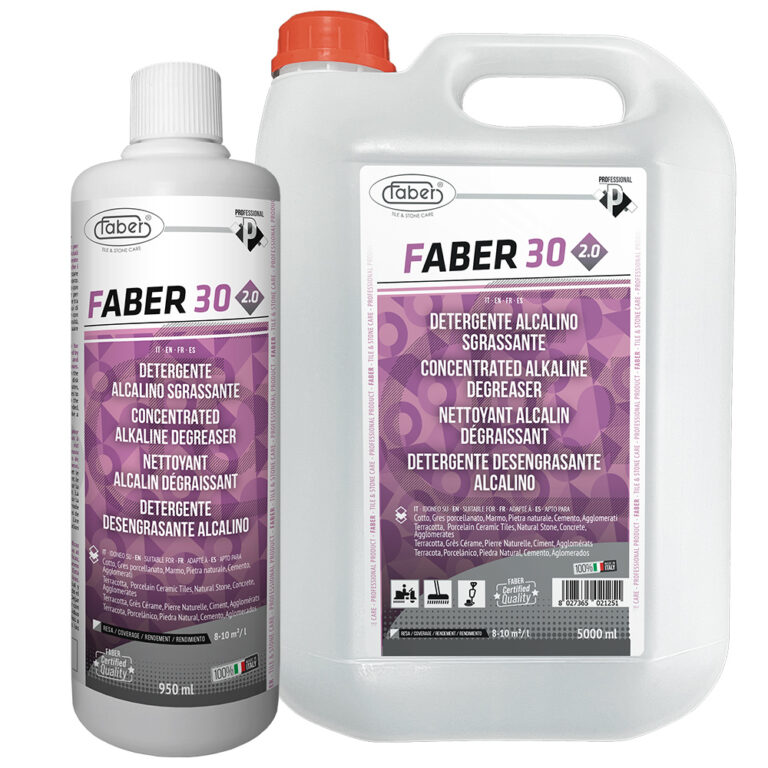
What Faber 30 2.0 is (and when to use it)
Faber 30 2.0 is a concentrated, alkaline cleaner for heavy-duty cleaning of greasy dirt and foot traffic dirt. According to its technical data sheet, it has a quick, strong cleaning action while remaining gentle on the surface, so it can be used on all hard surfaces, including polished marble and glazed, polished ceramics. It:
- is effective on different types of dirt, including grease, grime and tyre marks;
- deep cleans high-traffic areas;
- works on synthetic floors such as PVC, epoxy and polyurethane resins;
- can be used undiluted to dissolve wax, resins and polymers, including as the final stage of a double wax-stripping process;
- is suitable for indoor and outdoor surfaces.
Surfaces listed: marble, granite, limestone, travertine, sandstone, slate, quartzite, porphyry, terracotta, cotto, concrete and concrete tiles, glazed and craquelé ceramics, clinker, polished, natural and textured porcelain tiles, agglomerates and more.
What you need
- Faber 30 2.0 (950 ml or 5 litre bottles)
- Broom or vacuum cleaner
- A single-disc machine or large brush (or a hard floor cleaner)
- Pads: white for polished, delicate surfaces such as marble, limestone and glazed tiles; green or light blue for rough surfaces such as terracotta and concrete
- A wet vacuum, clean water and buckets
- Gloves, eye protection and non-slip footwear
Step-by-step: how to remove tyre marks from floor surfaces
- Remove loose dirt. Sweep or vacuum away dust, grit and debris.
- Test first on an unexposed area or spare piece.
- Choose the dilution. Neat for stubborn resin, wax or polymers. 1:2 for strong degreasing of large amounts of stubborn residue, a sensible starting point for heavy tyre marks and oily grime, or for site cleaning on acid-sensitive materials. 1:6 for periodic floor degreasing. Coverage is 8 to 10 m2 per litre.
- Work in small sections. On highly absorbent surfaces like terracotta, treat no more than 4 to 5 m2 at a time. On polished stone or ceramic tiles, the area can be larger.
- Apply and spread the solution evenly over the section with the single-disc machine or a large brush.
- Let it work for 10 to 15 minutes, running the machine over the area now and then to boost the cleaning action. On absorbent floors, add a little more product if needed so the surface stays covered with a thin layer throughout.
- Emulsify and remove. Pour enough clean water to form an emulsion, spread it with the machine or brush, then pick it up, ideally with a wet vacuum.
- Rinse thoroughly with clean water. If the result is not fully satisfactory, repeat.
- Reopen once dry. The floor can be used as soon as it is dry. If you plan to apply a sealer or treatment afterwards, wait until it is completely dry all the way through.
Tips and common mistakes
- Do not let the solution dry on the floor. Keep sections small and keep the surface wet during the dwell time.
- Do not apply on a wet or overheated surface; avoid hot, sunny porches at midday.
- Never mix it with other chemicals unless specified.
- On new floors, wait until adhesive and grout have fully cured.
- For daily cleaning afterwards, the data sheet recommends Faber Neugel or Faber Algafloor, depending on the material.
Safety and storage
Faber 30 2.0 is alkaline (pH about 11), so handle it with care.
- Wear gloves and eye protection and follow the safety data sheet.
- Protect nearby surfaces that are not being treated, and keep people off wet floors.
- Wash equipment with water after use.
- Keep the container tightly closed in a cool, dry place, out of reach of children. Shelf life is 36 months in the original sealed pack.
Frequently asked questions
Is Faber 30 2.0 safe on polished marble?
The data sheet says it is strong on dirt but gentle on the surface, and can be used on all hard surfaces including polished marble. Use a white pad on polished, delicate stone and test a hidden area first.
What dilution should I use?
Use it neat for wax stripping or stubborn resins and polymers, 1:2 for strong degreasing or site cleaning on acid-sensitive materials, and 1:6 as a periodic degreaser for floors.
Can it be used on epoxy or PVC floors?
Yes. The data sheet states it gives excellent results on synthetic floor coverings such as PVC, epoxy and polyurethane resins.
Need help?
Order Faber 30 2.0 from Flagstone Fix for your building or home. If you need to remove tyre marks from floor areas as large as car parks, porches or lobbies, our Stone Cleaning team can deep clean the floor with the right machines and pads. WhatsApp +91 87792 40420 to book.
Dealing with a different stain? Our stain removal guide has a stain-by-stain chart for marble, granite and tiles, covering oil, tea, coffee, rust, cement, hard water, epoxy, paint and mould.


