
Nano Protector Technology: How Nano-Sealing Improves Stain Resistance

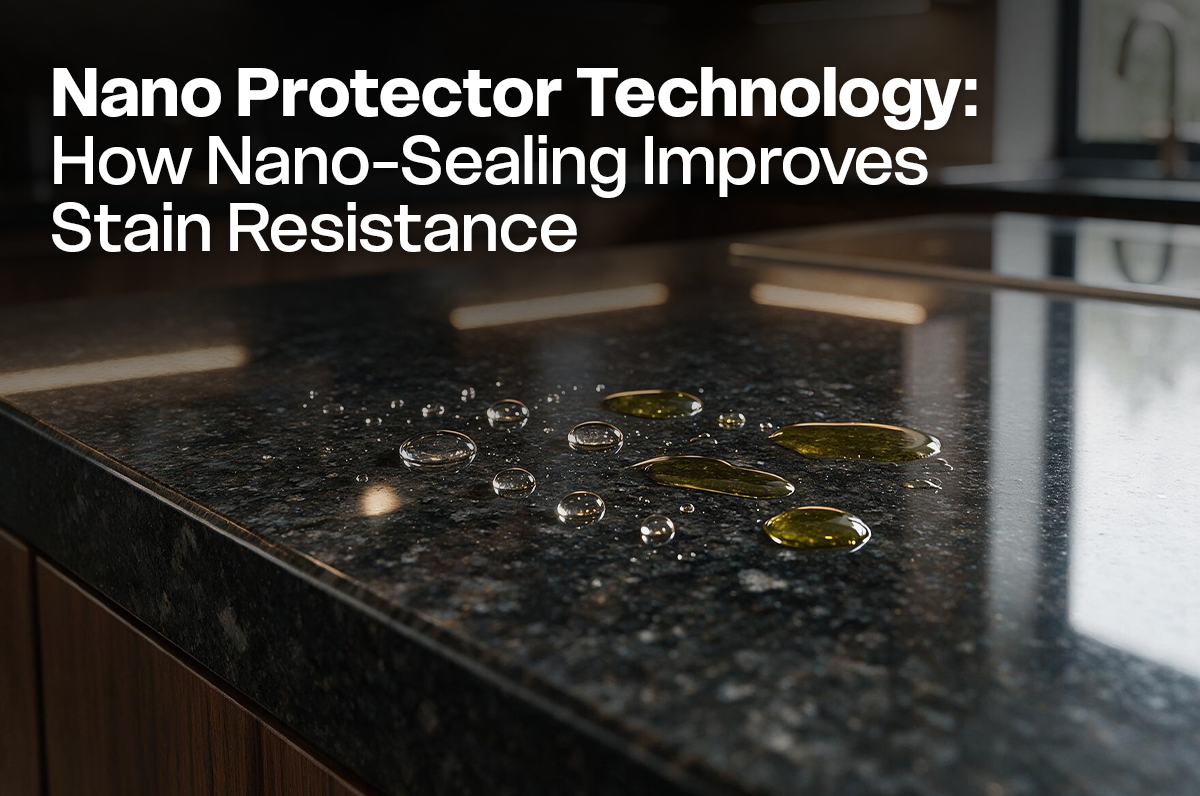
Nano-sealing refers to a sealer formulated with particles small enough to penetrate deep into a stone’s microscopic pore structure, rather than sitting on top of it as a film. In practice, that means FS Nano Power Protector, the flagship nano-technology product in the Flagstone Fix Protection range, creates an invisible barrier that blocks oil, water, and stains from within the stone, without changing how it looks.
What “Nano” Actually Means in a Stone Sealer
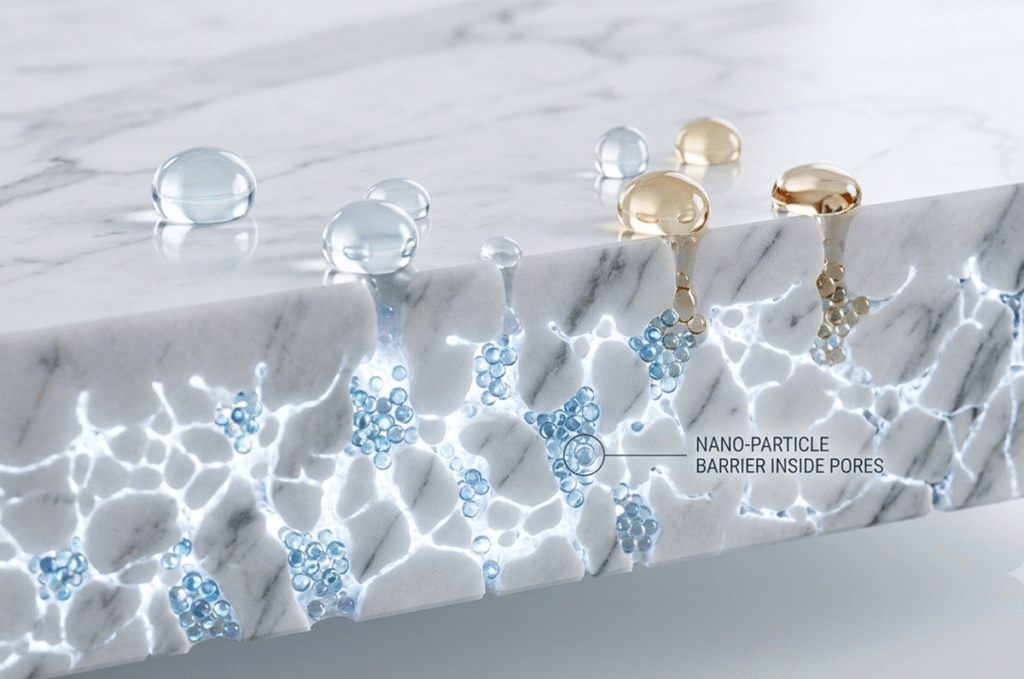
It’s a term used often enough in stone-care marketing that it can start to sound like a buzzword rather than a real technical distinction, but with sealers, it describes something specific and measurable. The term describes the scale of the sealer’s particles, not a marketing label. A conventional topical sealer forms a coating on the stone’s surface effectively, but it sits above the stone, can wear or scratch off with foot traffic, and can sometimes trap moisture underneath. A nano-formulated sealer is engineered with particles fine enough to move into the stone’s own capillary structure, occupying the same microscopic pores that would otherwise let oil, water, or staining agents soak in. The protection happens at the pore level rather than on the surface.
How FS Nano Power Protector Creates an Invisible Barrier
FS Nano Power Protector is a ready-to-use, solvent-based impregnator that “penetrates deep into the substrate to create an invisible subsurface shield,” rather than coating the surface. Because the barrier forms below the surface, the stone’s original colour, sheen, and texture are preserved; there’s no added gloss, no darkening, and no film that can peel or wear unevenly over time. The result is protection that behaves like part of the stone itself rather than an applied layer sitting on top of it.
What It Protects Against and Which Stones It Suits
FS Nano Power Protector is formulated to deliver an oil- and water-repellent finish with strong stain defence, and it’s particularly well suited to low-porosity, polished stones where a topical film would be most visible and most prone to wear. It’s formulated for granite, marble, limestone, onyx, travertine, flagstone, ceramic, grout, terracotta, and sandstone, covering both polished and unpolished finishes across most of the surfaces a stone care project is likely to include.
Nano Sealer vs. Traditional Topical Sealer
- Penetration: nano sealers work within the stone’s pores; topical sealers form a layer on top of the surface
- Appearance: nano sealers typically preserve the stone’s original look; some topical films add visible gloss or sheen
- Wear: because there’s no surface film, nano protection doesn’t scratch, peel, or wear thin from foot traffic the way a topical coating can
- Breathability: a well-formulated nano sealer allows trapped moisture vapour to escape rather than sealing it beneath a film
Where Nano Protection Delivers the Most Value
Nano-level protection tends to matter most on surfaces where a visible topical film would be a problem in itself: a polished marble lobby floor in a hotel where guests expect a natural, unaltered shine, a granite kitchen countertop that sees daily contact with oil and acidic foods, or a high-traffic commercial entrance where a surface coating would wear unevenly within months. It’s also a strong fit for restoration projects on older, already-polished stone, where the goal is to add protection without disturbing a finish that took years of use to develop. Because the barrier sits below the surface rather than on it, nano sealing is generally the more forgiving option wherever appearance and durability both matter and neither can be compromised for the other.

Applying FS Nano Power Protector for Best Results
Application is straightforward but benefits from patience: the product is applied with a saturated brush, roller, or mop, flooding the surface and keeping it visibly wet for 15–30 minutes so the formula has time to penetrate fully, before excess is wiped away with a clean, lint-free sponge. Coverage runs approximately 100–270 square feet per litre depending on the stone’s porosity and texture, and the treated surface needs a minimum 72-hour cure before it’s exposed to foot traffic or moisture, a detail worth planning around on an active renovation site.
A Note on Choosing Between Nano and Standard Sealers
Not every project needs nano-level protection; a lightly used guest bathroom or a low-traffic feature wall may do perfectly well with a standard impregnating sealer at a lower cost. Nano protection earns its place on surfaces that see the heaviest combination of exposure and visibility at once: kitchen countertops, high-traffic commercial floors, and any polished stone where both appearance and durability are non-negotiable. When in doubt, matching the product to the specific stone’s porosity and the space’s traffic level rather than defaulting to the most advanced option available is usually the more cost-effective decision, and it’s worth discussing with a Flagstone Fix applicator before committing to a product for a large-area application.
Frequently Asked Questions
Does nano sealer change how stone looks?
No, because FS Nano Power Protector penetrates below the surface rather than coating it, it preserves the stone’s original colour, sheen, and texture rather than adding visible gloss or darkening.
How long does nano protection last?
Longevity depends on the stone’s porosity, the amount of foot traffic, and how the surface is cleaned day to day, so it’s best to check the product’s technical data sheet for guidance specific to your application rather than assume a fixed lifespan.
Can nano sealer be used on polished marble?
Yes, FS Nano Power Protector is specifically suited to low-porosity, polished stones including marble, where a topical coating would otherwise be more likely to show wear or alter the finish.


