
How to Strip Old Wax and Sealer from Terracotta Floors
Yellowed, sticky or patchy wax on terracotta needs stripping before it can be resealed. Here is the step-by-step method with dilutions.

If you need to remove old wax from terracotta floors, you are not alone. Terracotta floors are usually waxed or sealed to protect them. Over the years those layers build up, turn yellow, trap dirt and wear unevenly, especially in walkways and kitchens. A floor that once glowed now looks blotchy and sticky. Adding more wax on top only makes it worse. The coating has to come off before the floor can be cleaned properly and treated again.
This guide is for homeowners with terracotta or cotto tiles, restoration contractors and facility teams handling old treated floors. It explains how to strip wax, resin and old treatments with Faber Cottosolv, including the double wax-stripping method for stubborn build-up.
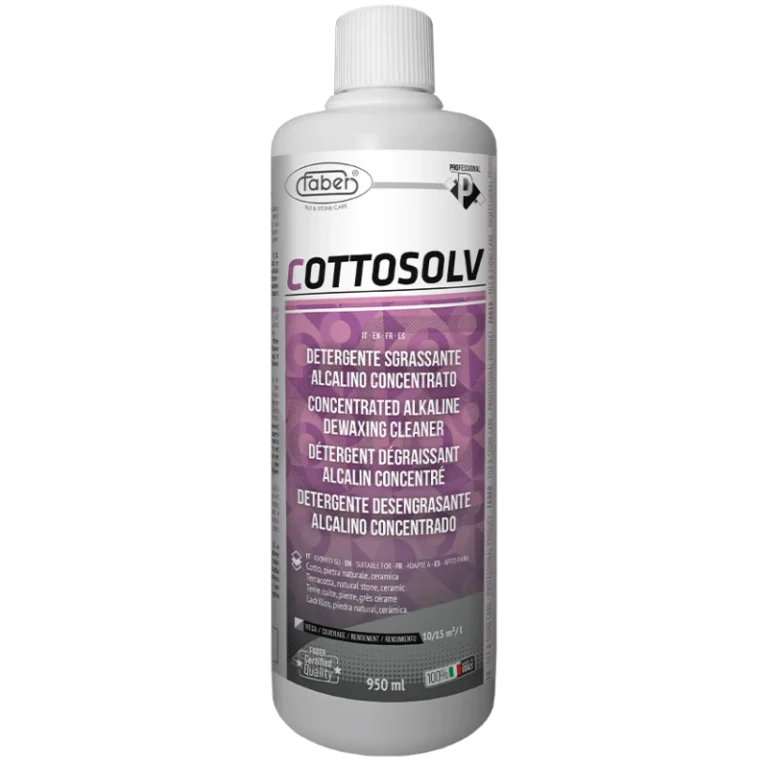
What Faber Cottosolv is (and when to use it)
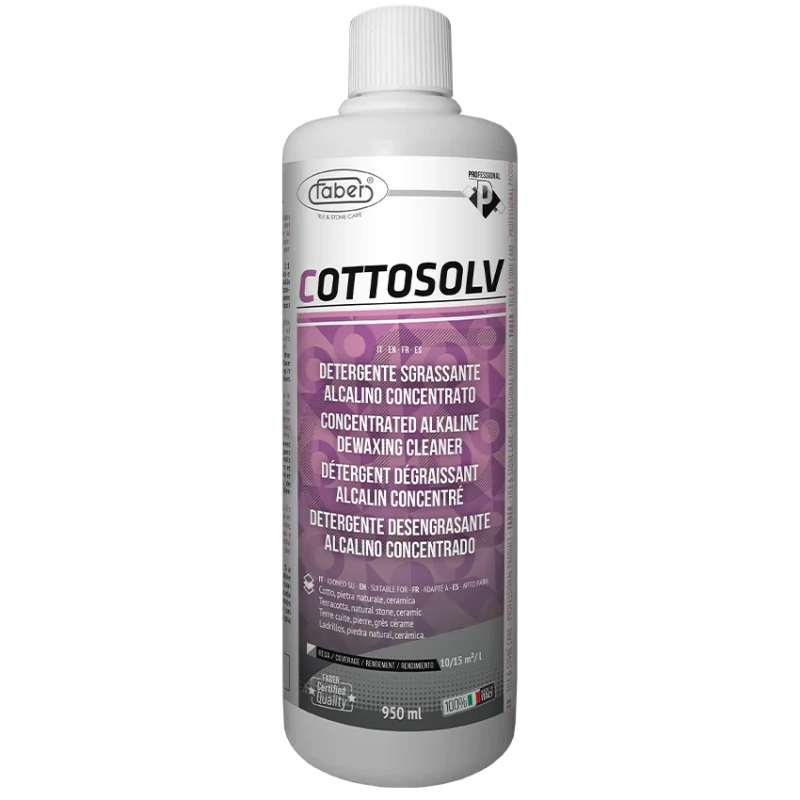
Faber Cottosolv is a highly concentrated alkaline degreaser (pH around 13). It is made for stripping wax, resin, polymers and other treatments, even when they are stubborn. It is also effective on greasy and oily stains and suits deep cleaning of walkable areas. It is often paired with Faber DEC 21, a solvent-based wax remover, for a “double wax stripping”.
It can be used indoors and outdoors on terracotta, cotto, concrete and concrete tiles, clinker, glazed and craquelé ceramics, all types of porcelain stoneware, marble, granite, limestone, travertine, slate, sandstone, quartzite, porphyry, tuff, basaltina, reconstituted stone and agglomerates. The data sheet also notes it suits synthetic floors.
When not to use it: do not apply it to a wet or overheated surface, or to newly laid floors before the adhesive and grout have fully cured. Do not mix it with any chemical other than Faber DEC 21.
What you need
- Faber Cottosolv (and Faber DEC 21 for double wax stripping)
- Clean water and a bucket for dilution
- A single-disc machine with suitable discs (green discs are normally used for wax stripping) or a large stiff brush
- A wet vacuum, or cloths and absorbent paper
- Broom or vacuum for pre-cleaning
- Rubber gloves, eye protection and rubber boots
Step-by-step: how to remove old wax from terracotta floors
- Remove loose dirt. Sweep or vacuum away dust and debris.
- Test a hidden area. Check the result on an unexposed spot or a spare tile.
- Protect nearby surfaces such as skirting, wooden doors and carpets.
- Choose the dilution. For stubborn wax, resin or polymers, use 50% in water; on absorbent materials such as cotto or concrete it can be used undiluted. For heavy degreasing, or worksite cleaning on acid-sensitive materials, dilute to 20 to 30% (1 part to 2 to 4 parts water). For periodic degreasing, use 10% (1 part to 9 parts water). Coverage is about 10 to 15 square metres per litre.
- Work in small sections. On highly absorbent terracotta, treat no more than 4 to 5 square metres at a time so the product does not soak in completely.
- Spread and scrub. Apply evenly and vigorously with the single-disc machine or brush, covering the whole section.
- Let it work 10 to 15 minutes. Pass the machine or brush over it at regular intervals. Top up on absorbent areas so the floor stays covered by a fine layer throughout.
- Emulsify and remove. Pour clean water onto the floor to form an emulsion, spread it with the machine, then pick up the slurry with a wet vacuum or absorbent cloths.
- Rinse well with clean water. If some treatment remains, repeat the process.
- Let it dry. The floor can be used once dry. Before applying a new treatment, wait until it is completely dry right through.
For very stubborn build-up: Faber DEC 21 + Faber Cottosolv
Apply ready-to-use Faber DEC 21 and work it in with the machine for 10 to 15 minutes, keeping the floor covered. Then apply Faber Cottosolv over the same area: undiluted on absorbent materials such as cotto and concrete, or diluted 50% on non-absorbent porcelain and ceramics. Work it for another 10 to 15 minutes, then emulsify with water, remove the residue and rinse.
Tips and common mistakes
- Keep the floor covered by a fine layer of product throughout the treatment. Keep sections small so you can remove the slurry in time.
- Pick the right disc. Choose a more or less abrasive disc for the material; green discs are typical for wax stripping.
- Rinse more than you think. The data sheet calls for a thorough rinse with clean water once the residues are removed.
- Be patient before resealing. Terracotta holds water. In humid Mumbai weather it may take longer to dry through.
Safety and storage
Faber Cottosolv is strongly alkaline. Wear gloves, eye protection and suitable PPE, and follow the safety data sheet. Keep children and pets away from the area. Equipment washes clean with water. Store tightly closed in a cool, dry place; shelf life is 36 months in the original sealed pack. Available in 1 litre and 5 litre bottles. For daily cleaning afterwards, the data sheet recommends Faber Neugel or Faber Algafloor depending on the material.
Frequently asked questions
What dilution should I use on terracotta?
For stubborn wax, resin or polymers the data sheet gives a 50% dilution, adding that on absorbent materials such as cotto and concrete Faber Cottosolv can be used undiluted. For periodic degreasing, dilute to 10% (1 part to 9 parts water).
What is double wax stripping?
It is a two-product method: first Faber DEC 21, a solvent-based wax remover, is worked into the floor for 10 to 15 minutes, then Faber Cottosolv is applied over it and worked for another 10 to 15 minutes before the residue is removed and the floor rinsed.
When can I reseal the floor?
Only when it is completely dry all the way through. The data sheet notes this varies with the type and absorbency of the material, so allow extra time for thick, absorbent terracotta.
Need help?
Buy Faber Cottosolv from Flagstone Fix, or let our crew remove old wax from terracotta floors for you through our Deep Cleaning service. WhatsApp us on +91 87792 40420.


