
Slip-Resistant Flooring for Hotels & Malls: An Anti-Slip Guide for Facility Managers


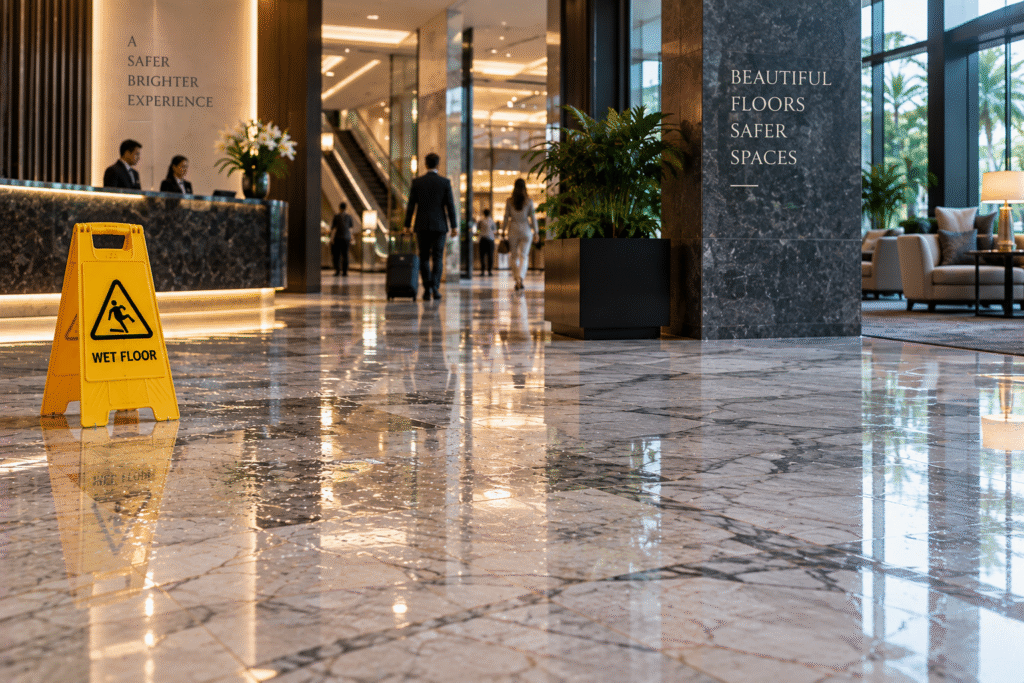
Anti-slip flooring for hotels, malls, and other commercial properties is one of the more overlooked line items in a facilities budget until an incident makes it urgent. Polished marble and stone floors are a defining feature of hotel lobbies, mall atriums, and commercial entrances across India and also one of the more common sources of slip-and-fall incidents, particularly when wet from rain, spills, or routine mopping. For a facility manager researching anti-slip treatment India options, this kind of non-slip treatment is one of the more cost-effective risk-reduction measures available, since it addresses the hazard at the floor itself rather than relying only on warning signage or staff vigilance.
Treating bathroom or wet-area tiles at home rather than a commercial floor? See our step-by-step guide to anti-slip tile treatment for bathroom tiles.
Why Polished Stone Floors Are a Slip Risk
A high-gloss polish is achieved by mechanically smoothing the stone’s surface until it reflects light; even the same smoothness that creates that premium look also reduces the surface friction a shoe needs to grip when the floor is wet. Add monsoon-season foot traffic tracking in water, a spilt drink in a food court, or a freshly mopped lobby floor, and a beautifully polished marble surface becomes a measurable liability, not just an aesthetic asset.
How Anti-Slip Treatment Actually Works
A treatment such as Safe Marble doesn’t work by adding a grippy coating on top of the stone; instead, it uses a controlled, acid-based formulation to create microscopic surface etchings in the stone that increase grip and accelerate water runoff, without changing the floor’s visual appearance or texture to the eye. Because the effect is mechanical rather than a topical layer, it doesn’t wear off the way a surface coating can, and it’s suited to marble (polished and honed), travertine, limestone, lime-based floors, concrete- and resin-marble agglomerates, and glazed porcelain tiles covering most of the flooring types found in hospitality and retail settings.
What This Means for Liability and Maintenance Budgets
Slip-and-fall incidents in commercial spaces carry real costs beyond the immediate injury investigation time, potential liability claims, reputational impact for a hotel or mall brand, and the operational disruption of an incident in a high-traffic public area. Anti-slip treatment is a comparatively small, one-time (or periodic) line item against that risk profile, and unlike many risk-mitigation measures, it doesn’t require ongoing staff training or behaviour change to be effective; it works passively, on every pair of shoes that crosses the floor, at all hours.
How Long Does the Treatment Last?
Under normal indoor conditions, the anti-slip profile from a treatment like Safe Marble is designed to remain effective indefinitely, but high-traffic commercial areas- a mall entrance, a hotel lobby that sees thousands of footsteps daily will generally need reapplication roughly every 12 to 24 months to maintain optimal grip. Building this into an annual or biennial facilities maintenance schedule, alongside routine deep cleaning and sealing, keeps the treatment performing at its intended level rather than letting it silently wear down between inspections.
One Important Limitation to Plan Around
Anti-slip treatments formulated for flooring, including Safe Marble, are typically not certified for direct food-contact surfaces such as countertops in a food-prep area; for those surfaces, a facility manager should specify a separate, food-contact-approved solution rather than assuming a flooring treatment is interchangeable. This distinction matters most for hospitality properties with open kitchens, buffet stations, or bar countertops adjacent to slip-treated public floors.
Comparing Anti-Slip Approaches
Facility managers typically have three broad options for a slippery stone floor: a permanent chemical treatment like Safe Marble that mechanically alters the surface texture at a microscopic level, a topical anti-slip coating or film applied over the stone, or a switch to a different, less-polished flooring material entirely during renovation. Coatings can improve grip but tend to wear unevenly under heavy commercial traffic and often need more frequent reapplication than a treatment that etches the stone itself. Replacing the flooring material is rarely realistic once a polished marble floor is already installed and forms part of a property’s brand identity. This is why a mechanical etching treatment tends to be the practical middle ground: it preserves the existing investment in the stone while directly addressing the friction problem.
Documenting Compliance and Due Diligence
Beyond the treatment itself, facility managers should keep records of when anti-slip treatment was applied, by whom, and when it’s next due for reapplication. This documentation becomes valuable evidence of due diligence should an incident ever occur, showing that reasonable, proactive steps were taken rather than the floor being left untreated after a known risk was identified. Pairing this with a routine wet-floor signage policy for spills between treatments rounds out a more complete slip-risk management approach.
Building an Anti-Slip Plan
- Prioritise entrances, lobbies, and areas near food and beverage service, where wet-floor risk is highest
- Combine anti-slip treatment with a durable sealer or densifier in the highest-traffic zones to protect against wear as well as slipping
- Schedule reapplication on a 12–24 month cycle for high-traffic commercial areas rather than waiting for a visible or reported issue
- Document the treatment and maintenance schedule as part of the property’s safety and liability records
Frequently Asked Questions
Will anti-slip treatment change how my marble floor looks?
No treatments like Safe Marble work through microscopic surface etching rather than a visible coating, so the floor’s appearance and texture remain unchanged to the eye while grip improves underfoot.
How often does commercial anti-slip flooring need retreatment?
Under normal conditions, the effect can last indefinitely, but high-traffic commercial floors typically need reapplication every 12 to 24 months to maintain the same level of grip, so it’s worth building into a regular facilities maintenance cycle.
Can anti-slip treatment be used on countertops in a food service area?
Flooring-formulated anti-slip treatments are generally not certified for direct food contact, so a separate FDA-approved solution should be specified for countertops and food-prep surfaces rather than extending a floor treatment to those areas.
See full technical details on the Safe Marble product page, or book an Anti-Slip Treatment assessment for your property.


