Colour-Matching Resin Filler to Your Marble or Granite
Make crack repairs and joints disappear by tinting polyester or epoxy resin to match your stone. Ratios, mixing tips and safety advice.


A crack repair or joint that is the wrong colour can be more noticeable than the damage it fixes. A glassy clear line through beige Indian marble, or a pale joint in a black granite counter, draws the eye straight to it. The answer is to tint resin to match stone colour, so the repair blends in.
This guide explains how to tint polyester and epoxy resins with Flagstone Fix Colouring Tint for crack filling, joints, counter repairs and restoration work. It is written for stone fabricators, flooring contractors and experienced DIYers who already work with resin mastics.

What Flagstone Fix Colouring Tint is (and when to use it)
Flagstone Fix Colouring Tint is a concentrated pigment paste for colouring polyester and epoxy resins. It blends into the resin to give a uniform, durable colour while maintaining the integrity of the resin.
It allows precise tinting for natural stone, tile and resin applications, and is intended for construction, restoration and decorative work. It is available in standard RAL shades, with custom colour matching on request. The safety data covers both a polyester version and an epoxy version, so choose the tint that matches the resin you are using.
When not to use it: it is formulated for colouring polyester and epoxy resins, not as a stain or wash for bare stone. Mix it into the resin rather than applying it to the stone itself.
What you need
- Flagstone Fix Colouring Tint in one or more shades
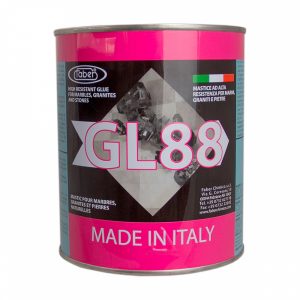
- A polyester or epoxy resin, for example Faber GL 88 marble mastic
- The resin’s own hardener or catalyst
- A digital scale, mixing board or cup, and a spatula
- An offcut or hidden area of the same stone for colour tests
- Nitrile gloves, eye protection and good ventilation
Step-by-step: how to tint resin to match stone colour
- Study the stone. Look at the background colour, not just the veins. Many marbles are best matched to the base tone, with the veining left to the stone around the repair.
- Weigh the resin. Measure out the amount you will use in one working session.
- Weigh the tint. Use the recommended 5% mixing ratio, for example 5 g of tint for 100 g of resin.
- Blend shades if needed. Two or more tints can be combined to reach the right colour. Keep the total pigment at about 5% of the resin weight.
- Mix the colour in first. Stir the tint into the resin until there are no streaks. With polyester mastics such as Faber GL 88, add colour before the hardener.
- Do a test dab. Add hardener to a small portion as per the resin’s instructions, apply it to an offcut and let it cure. Compare it in daylight.
- Adjust and repeat. Lighten or deepen the mix with a lighter or darker shade, then test again.
- Catalyse and apply. Add the hardener as the resin manufacturer specifies, mix thoroughly and fill the crack or joint.
- Finish. Once the resin has cured fully, grind and polish the repair flush with the stone.
Tips and common mistakes
- Stick to the recommended ratio. Keep the total pigment at about 5% of the resin weight, even when you blend several shades.
- Write down your recipe. Record the grams of each shade per 100 g of resin so you can repeat it on the next batch.
- Judge cured colour, not wet colour. Always compare a cured test piece before committing.
- Match the tint to the resin type. Use the polyester tint with polyester resins and the epoxy tint with epoxy systems.
- Mix small batches so the resin does not start setting while you fine-tune the shade.
Safety and storage
The safety data sheet for the polyester tint warns that it may cause an allergic skin reaction, serious eye irritation, and allergy or asthma symptoms if inhaled, and that it is suspected of damaging fertility or the unborn child and can damage organs through prolonged or repeated exposure. Do not breathe vapours, wear gloves and eye protection, use respiratory protection if ventilation is poor, and do not eat, drink or smoke while working. Wash thoroughly after handling, and keep away from ignition sources. The epoxy tint can irritate skin and eyes, may cause an allergic skin reaction and is toxic to aquatic life, so do not let it enter drains. If either gets in the eyes, rinse with plenty of water for at least 15 minutes.
Store tightly closed in a cool, dry, well-ventilated place, out of direct sunlight and away from extreme temperatures, acids and strong oxidisers. Store it locked up and out of reach of children, and keep water out of the epoxy tint. Do not dispose of it in sewage.
Frequently asked questions
How much tint should I add to resin?
The recommended mixing ratio is 5%, for example 5 g of tint per 100 g of resin. If you blend two or more shades, keep the total pigment at about 5%.
Can I brush Flagstone Fix Colouring Tint directly onto stone?
No. It is a pigment paste formulated for colouring polyester and epoxy resins, not a stain or wash for bare stone. Mix it into the resin instead.
Which colours are available?
It is available in standard RAL shades, with custom colour matching on request. Send us a photo of your stone and we will suggest a starting shade.
Need help?
Buy Flagstone Fix Colouring Tint from Flagstone Fix to tint resin to match stone colour yourself, or have our team colour-match and fill your joints with our Joint Filling with Non-Yellow Epoxy service. WhatsApp a photo of your stone to +91 87792 40420 and we will suggest a starting shade.