Epoxy Resining for Fragile Marble and Granite Slabs
Low-viscosity two-part epoxy is used to resin, seal and harden fissured marble and granite slabs. What it does and how to plan the job.


Many beautiful marbles and granites come with natural weaknesses: fine fissures, open veins, small voids and brittle zones. Slabs like these can crack during cutting, transport or installation, and the open pores and hairline fissures can trap dirt and moisture once laid. That is why many slabs are resined at the processing stage, using epoxy resin for marble slab reinforcement and the same approach on granite.
If you are working with fragile or fissured slabs, or restoring stone that needs consolidating, a low-viscosity epoxy is the usual tool. This guide explains what Faber GL 34 (A+B) does and how to plan the job. It is written for stone processors, fabricators and restoration contractors.

What Faber GL 34 (A+B) is (and when to use it)
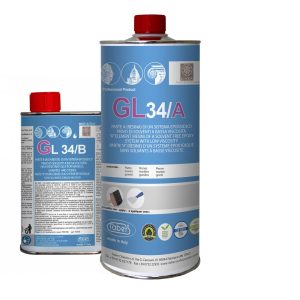
Faber GL 34 (A+B) is a two-component, low-viscosity epoxy resin system for reinforcing stone slabs. It is solvent-free, contains no fillers and hardens at room temperature. The two components are GL 34/A and GL 34/B.
It is used for resining, sealing and hardening marble, granite and other natural stone slabs. It can also be used for hardening by wall injection and for waterproofing porous, absorbent surfaces.
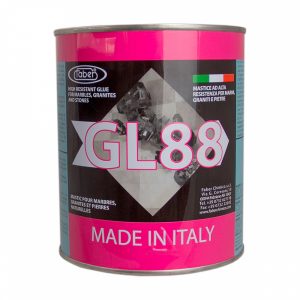
It is worth knowing how it differs from related products. Faber GL 88 is a marble mastic for gluing and grouting. GL 80 (A+B) is a two-part epoxy for repairing small and medium cracks. Faber GL 34 (A+B) is the one for resin-treating and consolidating natural stone.
When to choose something else: for gluing and grouting natural stone, Faber GL 88 is the mastic designed for that job, and GL 80 (A+B) is for repairing small and medium cracks. Always check the technical data sheet for surface suitability before use.
What you need
- Faber GL 34 (A+B), both components
- The technical data sheet or label instructions, for mixing ratio, working time and curing
- Accurate scales, clean mixing containers and stirrers
- Applicators suited to the job, as specified in the instructions
- Nitrile gloves, eye protection and protective clothing
- A well-ventilated, dry working area
Step-by-step: using epoxy resin for marble slab reinforcement
- Get the data sheet. Mixing ratio, pot life and curing times are on the label and technical data sheet. Contact Flagstone Fix if you do not have it.
- Assess the slabs. Note fissures, open veins and brittle areas, and decide which faces need treatment.
- Prepare the surface. The stone must be clean, free of dust and grease, and completely dry. Moisture in the stone is the enemy of a good epoxy bond.
- Test on an offcut. Check penetration and the final appearance before treating good slabs.
- Measure both parts accurately. Weigh A and B in the exact ratio given on the label.
- Mix thoroughly. Stir until fully combined, scraping the sides and bottom of the container. Mix only what you can use within the working time.
- Apply as instructed. Spread the mixed resin over the surface so it can flow into fissures and pores, and remove excess as the instructions direct.
- Allow it to cure at room temperature. Leave slabs undisturbed for the full curing time stated on the label.
- Finish. Once cured, the slabs can go on to calibration and polishing as normal.
Tips and common mistakes
- Never guess the ratio. Two-part epoxies need accurate measuring to cure properly.
- Work on dry stone. In the Indian monsoon, store slabs under cover and let them dry fully before resining.
- Don’t mix big batches. Epoxy starts curing once mixed, so work in manageable amounts.
- Use the right product for the defect. Low-viscosity resin for consolidating, mastic for gluing and grouting.
- Test before production. A trial on one slab saves a whole batch.
Safety and storage
Read the label and safety data sheet before use. As with any epoxy, avoid skin and eye contact: wear nitrile gloves, eye protection and protective clothing, and wash hands thoroughly after work. Work in a well-ventilated area, keep children and pets away, and do not let resin enter drains. Store both components tightly closed in their original containers in a cool, dry place, out of direct sunlight, and follow the label for shelf life and disposal.
Frequently asked questions
What is the difference between Faber GL 34 (A+B) and Faber GL 88?
Faber GL 34 (A+B) is a low-viscosity two-component epoxy for resining, sealing and consolidating stone slabs. Faber GL 88 is a marble mastic for gluing and grouting.
Does Faber GL 34 (A+B) need heat to cure?
No. It hardens at ambient room temperature.
Where can I get the mixing ratio and curing times?
Follow the product label, or contact Flagstone Fix for the technical data sheet before you start. Our team can also advise on quantity from photos and the area.
Need help?
Order Faber GL 34 (A+B), an epoxy resin for marble slab reinforcement, from Flagstone Fix, or let our specialists consolidate and restore your stone through our Complete Stone Restoration service. Send photos and the area on WhatsApp at +91 87792 40420 and we will recommend the product and quantity.