Dried Epoxy Grout on Tiles? How to Dissolve It Without Damage
Hardened epoxy grout lumps, resin and filler residue on tiles or stone can be dissolved with a solvent gel, and old epoxy joints opened for regrouting.


Epoxy grout is tough, stain-resistant and long-lasting, which is exactly why it is so hard to deal with when it ends up in the wrong place. A rushed tiling job can leave hardened lumps on tile faces, grey smears along the joints and resin stuck in the texture of matt tiles. Once cured, it does not wash off, and scraping risks scratching the surface. So how do you remove dried epoxy grout from tiles without damaging them?
New to epoxy grout? Start with our epoxy grout guide, including a calculator for how much grout you need.
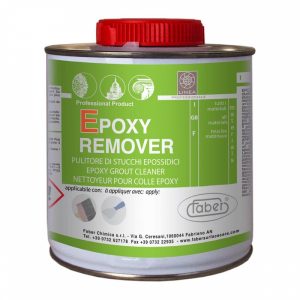
The answer is to dissolve it chemically. This guide explains how to use Faber Epoxy Remover to clear dried epoxy grout, resin and filler residue, and how to open up old epoxy joints before regrouting. It is written for tiling contractors, site engineers and homeowners dealing with a messy handover.

What Faber Epoxy Remover is (and when to use it)
Faber Epoxy Remover is a solvent-based stripper, a thick liquid, for thick residues of epoxy fillers, polyester fillers and mastics, enamels and synthetic materials sitting on a surface. Its formula can also bare epoxy grout joints when they need to be removed.
The data sheet lists marble, limestone, travertine, granite and polished porcelain among suitable surfaces; absorbent materials need longer contact, and a test on a hidden area comes first. Listed surfaces include lapped, polished, natural and textured porcelain stoneware, glazed ceramics, clinker, cotto, marble, granite, limestone, sandstone, slate, terracotta, concrete, cement grout, brick, glass, wood, steel and aluminium, indoors and outdoors.
When to wait: don’t use it on wet surfaces, and on recently laid or grouted floors, wait for the grout to cure completely.
What you need
- Faber Epoxy Remover (750 ml)
- A brush or spatula
- Absorbent paper or cloths; for larger areas a broom, absorbent rags and a damp mop
- White spirit for cleaning tools
- Solvent-resistant gloves, protective clothing, and eye and face protection
Step-by-step: how to remove dried epoxy grout from tiles
- Clean the surface. Remove dust and dirt so the gel contacts the residue directly.
- Check it’s dry. The surface should be dry, or at most only slightly damp.
- Pick the right time. Work between 5 and 40°C, not on heated surfaces, out of direct sunlight, and not when rain, frost or mist is expected. Morning or evening is best on terraces.
- Test a hidden area to check suitability.
- Apply a thick layer undiluted. Brush, spread with a spatula or pour it directly so the residue is fully covered.
- Leave it to act. Contact time depends on the residue and how absorbent the surface is: the data sheet gives 30 minutes up to 3 hours for epoxy, enamel or resin residues, and 5 to 10 hours to bare epoxy grout joints. For long dwell times, use a layer thick enough not to dry out.
- Remove the residue. On small areas, soak it up with absorbent paper or cloths. On larger areas, use a broom and rags or a damp mop until the excess is gone.
- Wipe and assess. Wipe with a slightly damp cloth or mop, let it dry fully and check the result. Repeat if needed.
- Rinse and dry. After rinsing with water, wait for the floor to dry completely before allowing foot traffic.
Tips and common mistakes
- Don’t chisel cured epoxy off polished tiles. Let the gel soften it first.
- Treat a whole tile or area. On absorbent surfaces, treating larger areas than the stain gives a more even finish.
- Plan regrouting time. Opening old epoxy joints takes hours of contact, so schedule it as a separate stage.
- Protect afterwards. Finish with a damp-proofing or stain-proofing treatment suited to the surface.
Safety and storage
Faber Epoxy Remover is highly flammable, with a flash point below 21°C. Keep it away from heat, sparks, open flames and hot surfaces, and don’t smoke nearby. It causes serious eye irritation and may cause drowsiness or dizziness, and repeated exposure may cause dry or cracked skin. Read the label, wear protective gloves, clothing, and eye and face protection, and ventilate indoor spaces well. Outdoors, protect nearby plants and finishes. Keep out of reach of children. Store tightly closed, upright, in a cool, dry place away from sunlight and heat; shelf life is 24 months in the original sealed pack.
Frequently asked questions
Can Faber Epoxy Remover open up old epoxy grout joints for regrouting?
Yes. The data sheet says it can bare epoxy grout joints, with a contact time of 5 to 10 hours.
Will it damage polished marble or tiles?
The data sheet lists marble, limestone and polished porcelain among suitable surfaces, but it makes no promise about keeping the shine, so test a hidden area or a spare tile first. Test a hidden area first.
How do I clean my tools afterwards?
Clean the equipment with white spirit at the end of the job.
Need help?
Buy Faber Epoxy Remover from Flagstone Fix to remove dried epoxy grout from tiles yourself, or let our team clear the residue and redo the joints with our Grouting & Regrouting service. WhatsApp +91 87792 40420 with photos of the problem.
Dealing with a different stain? Our stain removal guide has a stain-by-stain chart for marble, granite and tiles, covering oil, tea, coffee, rust, cement, hard water, epoxy, paint and mould.