Epoxy Grout Guide: Uses, How Much You Need and Haze Removal
Epoxy grout explained: epoxy vs cement grout, a calculator for how many kg you need, how to apply it, and how to remove epoxy grout haze from tiles.


Epoxy grout is a two- or three-part resin grout that sets hard, waterproof and stain-proof, so it does not need sealing and does not soak up dirt, oil or mould the way cement grout does. It costs more and is harder to apply, but in bathrooms, kitchens, pools and on large vitrified tiles it is now the default choice for many Indian contractors.
This guide explains when epoxy grout is worth it, how much you need (use the calculator below), how to apply it, and how to remove the haze it leaves on tiles. It is written by Flagstone Fix, the stone and tile care brand of Zyax Chem Pvt Ltd and an authorised partner of Faber Italy Tile & Stone Care.
Epoxy grout calculator
Epoxy grout vs cement grout
| Epoxy grout | Cement grout | |
|---|---|---|
| What it is | Resin and hardener, with coloured filler | Cement, sand and additives mixed with water |
| Water and stains | Non-porous: does not absorb water, oil or dirt | Porous: absorbs stains unless sealed |
| Sealing | Not needed | Needs sealing, and resealing over time |
| Mould in wet areas | Much more resistant | Darkens in showers and corners |
| Cleaning chemicals | Resists most household and acid cleaners | Acid cleaners erode it |
| Application | Short working time; surplus must be cleaned off before it sets | Easy and forgiving |
| Cost | Several times higher per kg | Low |
In short: cement grout is fine for dry living-room floors and walls. Choose epoxy grout for showers, bathroom floors, kitchen counters and backsplashes, swimming pools, commercial kitchens and anywhere you want joints that stay the same colour for years.
How much epoxy grout do you need?
Grout quantity depends on the tile size, the tile thickness and the joint width: small tiles and wide, deep joints use far more grout. The calculator above uses the standard formula grout makers publish, with 1.75 as the typical density of epoxy grout in kg per litre. Typical figures before wastage:
| Tile | 2 mm joint | 3 mm joint | 5 mm joint |
|---|---|---|---|
| 300 × 300 mm, 6 mm thick | 0.14 kg/m² | 0.21 kg/m² | 0.35 kg/m² |
| 600 × 600 mm, 9 mm thick | 0.10 kg/m² | 0.16 kg/m² | 0.26 kg/m² |
| 800 × 800 mm, 9 mm thick | 0.08 kg/m² | 0.12 kg/m² | 0.20 kg/m² |
| 600 × 1200 mm, 9 mm thick | 0.08 kg/m² | 0.12 kg/m² | 0.20 kg/m² |
| 25 × 25 mm, 4 mm thick | 1.12 kg/m² | 1.68 kg/m² | 2.80 kg/m² |
Mosaic tiles (the last row) need several times more grout per square metre than large-format tiles. Add about 10% for wastage and mixing losses.
How to apply epoxy grout
- Prepare the joints. Wait until the tile adhesive has set. Rake out spacers and loose adhesive so the joints are clean, dry and of even depth.
- Protect porous surfaces. On unglazed, matt, porous or light-coloured natural stone, pigment can stain the face. Apply a stain protector first and test on a spare tile; see sealing tiles before grouting for easy clean-up.
- Mix small batches. Mix all the components fully, in the ratio the maker gives, and only as much as you can use within its working time, which is short in Indian summer heat.
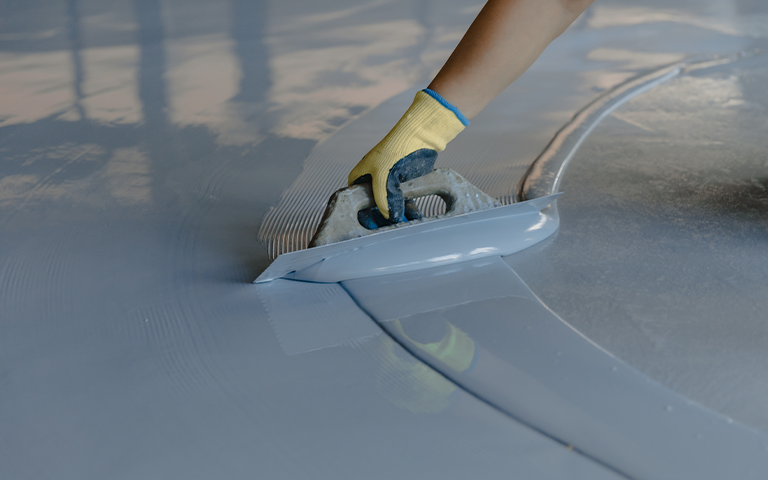
- Fill the joints. Press the grout diagonally across the joints with a hard rubber float until they are fully packed, then scrape off the surplus.
- Clean while it is still wet. Emulsify the residue with water and a scrubbing pad, then wipe with a damp sponge, rinsing it often. This is the step most jobs get wrong.
- Let it cure. Keep traffic and water off the floor for the time the maker gives before use.
How to remove epoxy grout haze from tiles
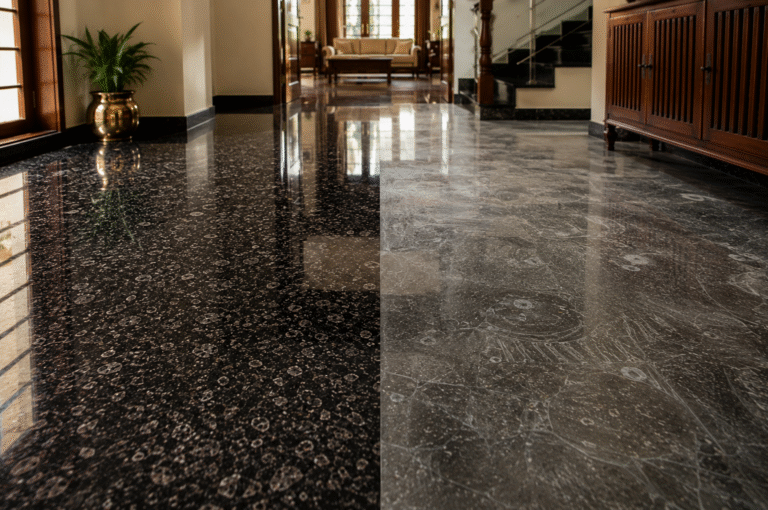
If residue is not cleaned off in time, it cures into a dull, sticky-looking film on the tiles that water will no longer remove. Faber Epoxy Residue Remover is a ready-to-use alkaline cleaner made for exactly this: it removes the films and haze left after grouting with epoxy products, whether you clean at the end of the job or weeks later. It is listed for indoor and outdoor surfaces including marble, granite, slate, concrete, terracotta and porcelain tiles; on polished or glazed polished porcelain, test first and reduce contact times if necessary.

For hardened lumps and thick smears, use Faber Epoxy Remover, a solvent-based stain remover for thick residues of epoxy grout, polyester fillers and putties, enamels and other synthetic materials. It is applied undiluted to dry surfaces. Our step-by-step guide covers it: how to remove dried epoxy grout from tiles.
Not sure how much remover you need? Use the coverage calculator: Faber gives 10–15 m² per litre for Faber Epoxy Residue Remover.
Cleaning and caring for epoxy grout
- Clean daily with a pH-neutral, no-rinse cleaner such as Faber Algafloor. Epoxy grout needs no sealer.
- Avoid wire brushes and abrasive powders, which dull the surface of the joints.
- On marble and other calcareous stone, never use acid cleaners, even though the grout itself can take them. Acids etch the stone around it. More in our bathroom tile cleaning guide.
- Outdoors and around pools, use a grout the maker rates as UV-stable; some epoxies change colour in strong sun.
Frequently Asked Questions
Is epoxy grout waterproof?
Yes. Cured epoxy grout is non-porous, so water, oil and stains stay on the surface instead of soaking in. That is why it is used in showers, pools and kitchens. The tiles and the layer beneath still need proper waterproofing in wet areas.
Does epoxy grout need sealing?
No. Unlike cement grout, epoxy grout is not porous and does not need a sealer. Clean it with a pH-neutral cleaner.
How much epoxy grout do I need for 100 sq ft?
For 600 × 600 mm vitrified tiles, 9 mm thick with 3 mm joints, about 1.6 kg including wastage. Smaller tiles and wider joints need more; use the calculator above for your tile size.
How do I remove epoxy grout haze from tiles?
Fresh haze comes off with water and a scrubbing pad while the grout is still wet. Once it has cured, use an alkaline epoxy residue remover such as Faber Epoxy Residue Remover. For thick, hardened lumps use Faber Epoxy Remover.
Can epoxy grout be used on marble?
Yes, epoxy grout works with natural stone, but coloured grout can stain porous or light marble. Protect the stone with a stain protector before grouting, test first, and clean the surplus off quickly.
Is epoxy grout better than cement grout?
For wet and heavy-use areas, yes: it resists water, stains, mould and cleaning chemicals and keeps its colour. Cement grout is cheaper and easier to apply, and is fine for dry floors and walls.
Need help with an epoxy grouting job?
Flagstone Fix supplies the Faber Italy range of epoxy residue removers, tile cleaners and stain protectors to contractors and homeowners across India. Send a photo of the tiles on WhatsApp at +91 87792 40420 and our team will recommend the right product, or ask for bulk pricing for site quantities. Browse all tile cleaners.
Products mentioned in this guide
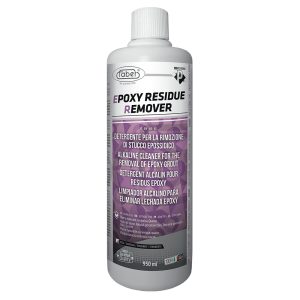 Faber Epoxy Residue RemoverFaber Epoxy Residue Remover for Tile & GroutView product →
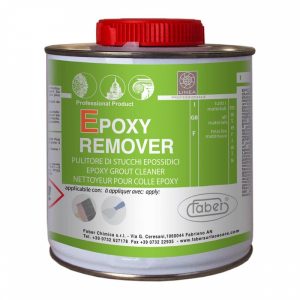 Faber Epoxy RemoverStain remover for high-thickness epoxy residues and synthetic residues, such as polishes and resins.View product →
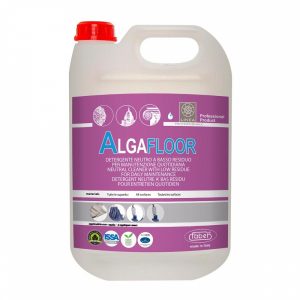 Faber AlgafloorFaber Algafloor pH-Neutral Stone Cleaner for Porcelain, Ceramic & TileView product →