Marble Crack Repair: How to Fix Cracks in Marble Floors and Countertops
How to tell a crack from a natural fissure, which filler to use for each kind of crack in marble, and how to fill, cure and re-polish it.


A crack in a marble floor or countertop is one of the most common problems we see in Indian homes and buildings. The good news is that most cracks can be filled so they are hard to spot, and the stone can be polished again over the repair. This guide explains how marble crack repair works, how to tell a crack from a natural fissure, which filler to use for each kind of crack, and when to call a professional.
Every product named here is from the Flagstone Fix and Faber Italy range, and the directions come from each product’s technical data sheet or product page. If you would rather have it done for you in Mumbai, our crack and pinhole filling service handles it.
Crack or fissure? Know what you are fixing
Not every line in marble is damage. Marble is a natural stone and many slabs have fissures: natural veins and hairline openings that formed in the quarry. Factories often fill them with resin before the slab is polished. A crack is a break that appeared after installation, usually because of a load, an impact or movement in the floor below.
As a general check, run a fingernail across the line. A fissure that follows the veining and feels smooth is usually natural. A line that cuts across the veining, catches your nail, or has a slight height difference on each side is a crack. If a tile sounds hollow when tapped next to the crack, the bedding underneath has failed, and filling the crack alone will not hold.
Why marble cracks
- Load and impact: heavy furniture, a dropped object, or point loads on thin slabs.
- Movement below the floor: settling of the screed or building, or hollow spots left when the stone was laid.
- No expansion gaps: large floors laid tight against walls, with no room for the stone to move with temperature.
- Weak spots in the slab: natural fissures that open up over time under traffic.
Which crack filler to use
The right filler depends on the width of the crack, the colour of the stone, and whether the surface is a floor or a wall. Epoxy fillers cure harder and resist yellowing better, while polyester fillers cure faster and are easier to work and polish.
| Crack | Recommended filler | Why |
|---|---|---|
| Hairline cracks and micro-fissures across a floor | Faber GL 80 Epoxy (A+B) | Low-viscosity, solvent-free epoxy that penetrates deep into the stone; made to repair small and medium cracks in marble, granite and natural stone |
| Cracks in white or light-coloured marble | Flagstone Fix Flagpox Pro 777 Surface & Joint Filler | Solvent-free two-part epoxy for natural cracks and fissures in white and light stone, with UV resistance and stable, non-yellowing colour |
| Wide cracks and larger damaged areas, clear finish | Flagstone Fix Crack Fill Waterclear | Two-part water-clear polyester filler; its liquid form suits wide gaps and larger surfaces and cures to an invisible finish |
| Thin cracks on polished floors, clear finish | Flagstone Fix Transparent Liquid | Two-part UV-stabilised liquid polyester for surface and joint filling; flows quickly and evenly over large areas |
| Cracks on walls, cladding and vertical faces | Flagstone Fix Waterclear Gel Special | Soft, creamy two-part polyester that stays put on vertical surfaces |
| Coloured cracks that must match the stone | Flagstone Fix Mastic Liquid or Flagstone Fix Mastic Soft with Flagstone Fix Colouring Tint | Polyester mastics that sand and polish with the stone; add up to 5% tint to match the colour |
For broken slabs and pieces that have come away, see how to repair a broken marble slab; for edges, see chipped countertop edge repair; and for strengthening a fragile slab from the face, see epoxy resining for marble slabs.
Step by step: how to fix a crack in marble
- Clean and dry the crack. Remove dust, grease and loose material from inside the crack. Every filler here needs a clean, dry surface to bond.
- Protect the surrounding stone. Mask the area around the crack so excess resin is easy to remove.
- Test first. Try the filler on a small, hidden area to check the colour and finish. The Faber GL 80 data sheet specifically recommends this to check for any colour change.
- Tint if needed. For coloured stone, mix up to 5% Flagstone Fix Colouring Tint into the polyester filler before adding the hardener, and match the colour on a sample.
- Mix exactly. Faber GL 80 mixes 100 g of part A to 44 g of part B by weight, and the data sheet warns that changing the ratio can stop it hardening properly. The Flagstone Fix polyester mastics take 1 to 4 g of hardener per 100 g; more than 4% weakens adhesion and surface curing.
- Fill slightly proud. Work the filler into the crack with a spatula, leaving it just above the surface so it can be levelled once hard. With the polyester mastics, keep each layer no thicker than 2 mm.
- Let it cure. Faber GL 80 needs at least 15 hours before honing. The Flagstone Fix mastics can be worked after 6 to 8 hours. Warm weather speeds curing and cold slows it; do not use Faber GL 80 or Flagpox Pro 777 below 10°C.
- Level and re-polish. Remove the excess, then hone and polish the area back to the surrounding finish. For Faber GL 80 floor treatments, the data sheet describes honing with 400 and 800 grit and finishing with polishing powder. See our marble polishing guide for the polishing step.
When to call a professional
Small, stable cracks are a reasonable DIY job. Call a professional if the crack keeps widening, runs across several tiles, if the tile sounds hollow, or if the floor is a large polished area that will need machine honing to blend the repair. Our crack and pinhole filling service covers homes and buildings across Mumbai, and larger jobs can be combined with complete stone restoration.
Frequently asked questions
Can a crack in marble be repaired so it does not show?
In most cases, yes. A clear filler such as Flagstone Fix Crack Fill Waterclear cures to an invisible finish, and coloured cracks can be matched with Flagstone Fix Colouring Tint before the area is honed and polished. Very wide or moving cracks are harder to hide.
Is epoxy or polyester better for marble crack repair?
Epoxy, such as Faber GL 80 or Flagstone Fix Flagpox Pro 777, penetrates fine cracks and keeps its colour, which matters on white marble. Polyester fillers cure faster and are easier to sand and polish, which suits wider cracks and quick repairs.
How long does marble crack filler take to dry?
It depends on the product. Faber GL 80 needs at least 15 hours before honing. The Flagstone Fix polyester mastics can be worked after 6 to 8 hours. Cold weather slows curing.
Will the repair turn yellow?
Flagstone Fix Flagpox Pro 777 is a non-yellowing epoxy made for white and light stone. The polyester fillers are UV-stabilised, but their product pages note that slight yellowing may occur outdoors over time.
What are fissures in marble?
Fissures are natural veins and hairline openings in the stone that formed in the quarry. They are often filled with resin at the factory. If one opens up, it can be filled the same way as a crack, typically with a low-viscosity epoxy such as Faber GL 80.
Is there a marble crack repair kit?
Rather than a fixed kit, choose the filler for your crack from the table above, add Flagstone Fix Colouring Tint if the stone is coloured, and use a spatula and polishing products to finish. Our team can suggest the exact combination on WhatsApp.
Buy marble crack fillers from Flagstone Fix
Browse the full mastics and epoxy range, read our guide to marble adhesives and glue, or send a photo of the crack on WhatsApp at +91 87792 40420 and we will recommend the right filler.
Products mentioned in this guide
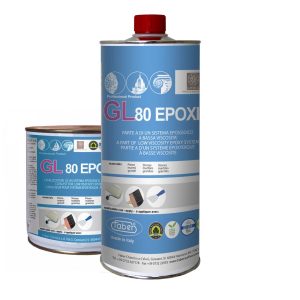 Faber GL 80 Epoxy (A+B)Faber GL 80 Epoxy (A+B) Epoxy Crack Repair for Natural StoneView product →
 Flagstone Fix Flagpox Pro 777 Surface & Joint FillerNon-Yellowing EpFLAGPOX PRO 777 Non-Yellowing Epoxy Surface & Joint Filler for Surface and Joint FillingView product →
 Flagstone Fix Crack Fill WaterclearPolyester adhesive for filling and fixing natural stone.View product →
 Flagstone Fix Transparent LiquidFlagstone Fix Transparent Liquid stone filler for Natural StoneView product →
 Flagstone Fix Waterclear Gel SpecialFlagstone Fix Waterclear Gel Special Polyester Crack Filler for Granite, Marble & StoneView product →
 Flagstone Fix Mastic LiquidFlagstone Fix Mastic Liquid Stone Adhesive for Natural & Artificial StoneView product →